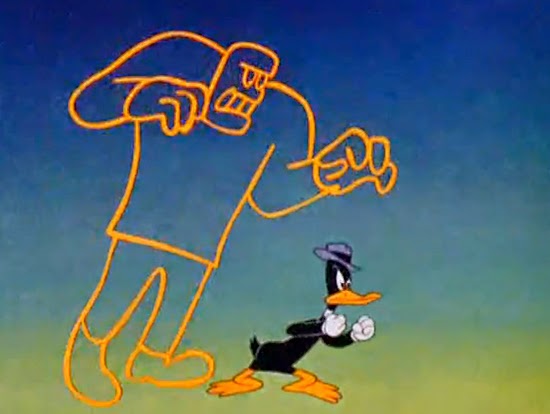
Descriptively named “Neon Noodle”, this unusual Frankenstein
Monster is beautifully animated, casting a soft neon glow, switching from blue
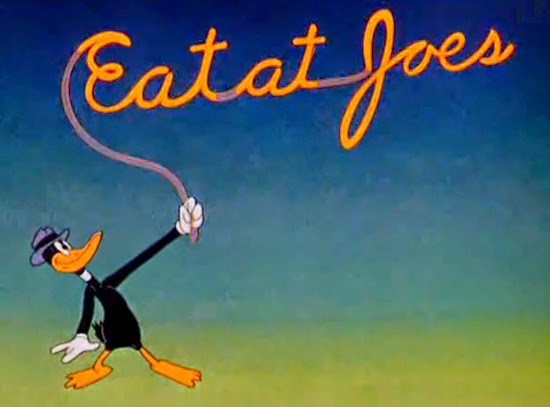
to orange and yellow. In a surrealistic scene, Daffy dispatches Neon Noodle by
snapping and twisting him into an “Eat at Joe’s” neon sign. All the other
bizarre bad guys are tommy gunned in a gloriously gratuitous scene deemed so
violent that it was cut when the cartoon played on TV. A restored version would
be the very first short shown when The Cartoon Network launched in 1992. Among
the film’s admirers is John Kricfaluzi, creator of Ren and Stimpy, who said, “I saw this thing and it completely
changed my life.” February 4, 2015
The Great Piggy Bank Robbery (1946)
Descriptively named “Neon Noodle”, this unusual Frankenstein
Monster is beautifully animated, casting a soft neon glow, switching from blue
to orange and yellow. In a surrealistic scene, Daffy dispatches Neon Noodle by
snapping and twisting him into an “Eat at Joe’s” neon sign. All the other
bizarre bad guys are tommy gunned in a gloriously gratuitous scene deemed so
violent that it was cut when the cartoon played on TV. A restored version would
be the very first short shown when The Cartoon Network launched in 1992. Among
the film’s admirers is John Kricfaluzi, creator of Ren and Stimpy, who said, “I saw this thing and it completely
changed my life.” January 18, 2015
Bubble and Squeek in Old Manor House (1947)
The driving force behind the cartoons was American-born George Moreno Jr., late of the Fleischer Studios, who settled in England and launched British Animated Productions (B.A.P.), making a bold attempt at creating homegrown Technicolor cartoons for British cinemas. Unfortunately, the project collapsed quickly when wartime restrictions on foreign products were lifted and the market was instantly flooded with American-made cartoons.
The fourth and final Bubble and Squeek title, OLD MANOR HOUSE, has our heroes seeking refuge
from a typical monster-movie-style wind and rain storm inside the title’s
“creepy place”, occupied by a belligerent, monocle’d and mustachioed rodent
named Colonel Rat. Clocking in just short of 7 minutes, it’s a brisk and manic
affair with Bubble and his car subjected to frights that include a nice cameo
of a Frankenstein Monster — an absolute requisite character in any scary Old
Manor House. Identified as “Frankie Stein’, with forehead wingnut bolts, the
Monster moves mechanically, utters a dainty “Boo!”, and exits through the wall,
leaving his distinctive silhouette in classic cartoon cutout. Labels: Animation
March 10, 2014
Boris Karloff in Aunt of Frankenstein
At the show, George sees a Government film about saving bones to be used, we learn, to
make explosives, glue and fertilizer. Our patriotic skeleton donates himself to
the war effort and is transformed into a shell that chases Hitler himself back
to Berlin. December 7, 2012
Frankenstein Meets Gandy Goose
A description, with screencaps, of G Man Jitters, on Cartoons of 1939.
Labels: • G Man Jitters (1939), Animation
July 18, 2011
Frankensteined Girl
Killed in a lab accident, a girl is frankensteined back to life by Victor, her mad scientist boyfriend. Problems ensue.
Here’s a lovely stop-motion short, a fresh take on an oft-told story, directed by David Cowles, Jeremy Galante and Brad Pattullo. It’s set to (Baby) It’s You, written by Danny Shonerd and Allen Havicek, performed by The Boys.
Enjoy!
Baby, It’s a Blog, the official blog and production diary of the film.
Found on Danny Shonerd’s Tumblr.
Labels: Animation
March 25, 2010
Porky's Road Race
Karloff’s Frankenstein Monster was an instant favorite with animators, appearing in droll cameos or as the story’s main menace in numerous cartoons throughout the Thirties and Forties. Karloff himself was also featured in a few cartoons, usually caricatured in gaunt deadpan. With Porky’s Road Race, in 1937, both The Monster and the celebrated actor were merged into one villainous, flat-headed character named “Borax Karoff”.
The simple story has Porky Pig driving his tiny roadster in a big race against Hollywood movie stars the likes of W.C.Fields, Laurel and Hardy, and John Barrymore. Charlie Chaplin appears wielding wrenches, Modern Times-style, and Charles Laughton is portrayed as Mutiny on the Bounty’s Captain Bligh, otherwise, most of the famous faces here are mostly forgotten today. George Arliss, anyone?

Borax Karoff is prominently featured, and he is the best-realized character in the piece with his elongated jaw, sawed-off head and Frankenstein bangs, unibrow and raccoon eyes. Borax drives a souped-up, 30-foot long, finned and streamlined speedster — Number 13, of course — with a death’s head hood ornament. He throws tacks, grease, glue and a torpedo at the competition to take the lead. On the home stretch, with every one else sidelined, Porky and Boris sprint for the finish line. Guess how it ends.
Comedy-wise, there’s not a lot going on here. There’s none of the wild creativity that we usually associate with the famous Warner Brothers “Termite Terrace” artists. This cartoon relies entirely on its star cameos for laughs that, I suspect, weren’t very loud even in 1937.

The seven-minute short was animated by Bob Bentley and Joe D’Igalo, under the direction of Frank Tashlin. Writer Allen Rose’s credits include Man of Tin, a 1940 cartoon featuring a Frankensteinian mad scientist and his robot creation.
Porky’s Road Race is distinguished for being voice master Mel Blanc’s first picture, providing Porky’s hiccups (and, I’m guessing, the “putt putt” sound of squirting oil cans). Blanc, incredibly, would go on to voice over one thousand cartoons! Borax Karoff’s sinister cackles were recorded by Billy Bletcher, a character actor and frequent cartoon voice artist. Bletcher, whose career spanned over fifty years, may be best remembered as the mad lab hunchback assistant “Gorzo” in the bizarre science fiction serial The Lost City (1935).
Porky’s Road Race is currently online here.
Related:
More vintage cartoons:
Porky’s Movie Mystery
Frankenstein’s Hollywood Capers
Frankenstein Meets Mickey Mouse
The Snow Man
Labels: Animation, Boris Karloff
March 5, 2010
Gruesomestein's Monsters
Gruesomestein’s Monsters was a series concept developed through the early part of the last decade for Toronto-based Nelvana studios. Created, written, produced and directed — with voice acting thrown in — by Mark Ackland and Riccardo Durante, the project yielded six 5-minute Flash animation shorts that ran as part of the Fun Pack program on the Canadian kids network YTV. One episode, Russell’s Tussle, made the competition list at the Chicago International Children’s Film Festival in 2005.
The show, beautifully designed, drops its outrageous monster characters into whacked out situations. There’s a witch that runs afoul of “Fairy Tale Land” laws — some rule against cooking children — and a Jekyll-Hyde character messes with a bank robber on the lam. There’s an obvious love of classic movie monsters at work in a Teenage Werewolf episode set in the rock n’roll Fifties, and a Yeti story unfolds in “Cushing Falls National Park”, a reference to the early Hammer horror, Abominable Snowman of the Himalayas. A Frankenstein episode, The Worst Date, is done in vintage black and white.
The Worst Date features a mad scientist, a hunchbacked assistant, and a cute Bride character with sutured neck and trademark beehive. When her milquetoast beau comes to the castle to pick her up, he becomes an instant candidate for a one-way brain transplant, for the benefit of a hulking, drooling, comatose Monster with glassy eyes.
Here, for your viewing pleasure, is the Frankenstein episode: The Worst Date.
All six episodes of Gruesomestein’s Monsters are online. The show’s blog archives are loaded with fascinating info, design and production art. I wish they had made more of these.
November 10, 2009
Porky's Movie Mystery
With Frankenstein, in 1931, an instant icon was created. The film’s extraordinary Monster was quickly adopted by animation studios as imminently caricaturable, his impossible flat head, neck bolts, dead man’s stare and morbid mobility used as shorthand for all that is otherworldly and menacing.
By the time Porky’s Movie Mystery was released in March 1939, the writers and artists at Leon Schlesinger’s studio, producing animated shorts for Warner Brothers, had already featured The Monster as a Karloffian menace in Porky’s Road Race (1937) and as an improbable Hollywood star in Have You Got Any Castles? (1938). He would appear again, as a frightening robot, in Sniffles and the Bookworm, in December ‘39. In Porky’s Movie Mystery, interestingly, The Monster plays against type.

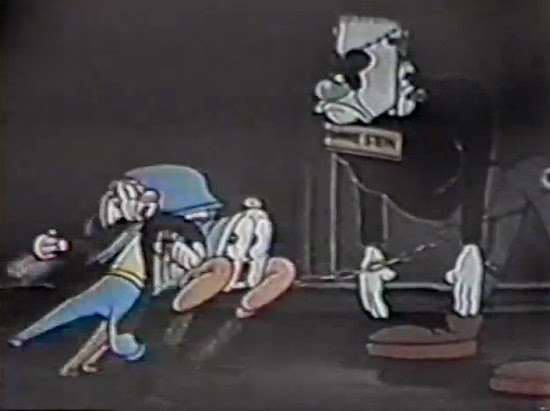
As the cartoon opens, a newspaper headline announces that movie villains (curiously misspelled on screen) are being quizzed over mysterious goings-on in Hollywood. A chained Frankenstein Monster is grilled by a tough-talking cop. Despite his sporting a row of pointy teeth and enormous, hairy and clawed hands, this Monster is terrified, gnawing his fingernails by running them through his mouth like a typewriter carriage, complete with the sound of a return bell. I wonder how the joke plays today. How old do you have to be to remember typewriters, or to have ever heard a typewriter bell?
The sequence is quickly over, the policeman barking, “Come clean, you blankity-blank monster! Are you The Phantom?” The Phantom in question is glimpsed as a cackling, cloaked figure who, according to a radio bulletin by “Walter Windshield” is “haunting studios in Hollywood, panicking actors, ruining pictures and creating havoc in the film capital!”
Borrowing again from Universal pictures, the mysterious figure is soon revealed to be… The Invisible Man! “They starred me in one picture,” he complains. “Then dropped me!”
Expert help is needed, and the police call on “Mr. Motto” — Porky Pig in Oriental guise — this time lampooning the detective character, Mr. Moto, played by Peter Lorre at 20th Century Fox. Confronting The Phantom, Porky is pinned to a wall and, just as he is about to be hacked with an axe, he pulls out and consults his Ju-Jitsu manual. In the ensuing fight, The Phantom is knocked out, sprayed with “anti-invisible juice” and revealed to be… Well, you’ll have to watch it yourself and see if you can identify the character. The problem with topical humor is that it rarely outlives its specific time frame.

Porky’s Movie Mystery is pretty pedestrian, nowhere near as imaginative and explosively funny as so many of the other Warner cartoons that came out of the run-down bungalow known as Termite Terrace. There’s only one really ingenious gag, a nice visual achieved when the Invisible Man hides by standing in front of movie poster, dressing a swimsuit beauty with the hat, gloves and shoes that he is wearing. Otherwise, the script by Robert Gee is thin on jokes and the action is unmemorable.
Head animator John Carey would move on to comic books, where he made his name drawing Warner, Disney and Hanna-Barbera characters. Producer Robert “Bob” Clampett, who originally designed the Porky Pig character, enjoyed an illustrious if sometimes controversial career in animation, supervising some of Warner’s most crazily inspired cartoons through the Forties and eventually creating Beanie and Cecil for early television in both puppet and animated versions.
Porky’s Movie Mystery may have drawn a few chuckles when it was new, but it hasn’t held up very well. Its last, enduring distinction is a cool cameo by the Frankenstein Monster.
Watch Porky’s Movie Mystery on YouTube.
Related:
Frankenstein’s Hollywood Capers
Frankenstein Meets Mickey Mouse
Frankensteinian: The Snow Man
Labels: • Porky's Movie Mystery (1939), Animation
March 31, 2009
Frankenstein's Hollywood Capers

Labels: Animation, HOLLYWOOD CAPERS (1935)
January 19, 2009
Frankenparts
It’s all here in glorious black and white: The desolate landscape, the ominous skies, the isolated windmill, the fleeing Monster — topped off with a comic twist — and delivered in one minute, flat.
Frankenparts is a 3D animated student film made at the Vancouver Film School in 2006 by Peter Crafts. The short was a finalist in the 2008 Aniboom Awards.
Enjoy!
Frankenparts on Aniboom.
Peter Crafts’ website.
Labels: Animation
November 22, 2008
Frankenstein Meets Mickey Mouse
The Mouse, created by Walt Disney and Ub Iwerks, first graced the screen in 1928. The Monster, assembled by James Whale, Jack Pierce and Boris Karloff, followed in 1931. Twentieth Century icons, their parallel paths would intersect twice in the first sixty years of their ongoing careers.
The phenomenally successful Frankenstein made its Monster an instant cultural reference, signaled by appearances in three animated shorts in 1933. Betty Boop’s Penthouse features a laboratory-made, wraith-like Frankenstein menace, and Bosco’s Mechanical Man is a frenzied robot called Frankensteen. It fell to Mickey’s Gala Premiere to present the first recognizable representation of the Karloff Monster.
The story — Mickey’s new picture premieres in Hollywood — serves as an excuse to caricature a parade of then current movie idols, from the Marx Brothers, Greta Garbo and Mae West, to now largely forgotten stars like George Arliss, Chester Morris and Mark Swain. The Frankenstein Monster appears in the company of Bela Lugosi’s Dracula and a missing link-like Fredric March as Mr. Hyde. The monstrous trio, enjoying the show, laugh in perfect unison. According to studio archives, the sequence was animated by Art Babbitt.
What’s interesting here is that the animator’s reference was obviously a photo of an unused, early test makeup that had curious fleshy folds, or ‘horns’, on the forehead. Babbitt replaced the circular clamps with safety pins and added electric wires to the neck bolts.

In 1995, Mickey Mouse became the Frankenstein Monster in Runaway Brain, an energetic short where Mickey’s brainwaves are switched with that of a giant creature with a peg leg and a flat Frankenstein skull. The film, nominated for an Academy Award, was directed by Chris Bailey.
In the age of YouTube, Mickey’s Gala Premiere, unseen for many years, is now freely available on the Net (see how many Golden Age movie stars you can ID!), as is the entertaining Runaway Brain.
September 25, 2008
Flash for Frankenstein
Out of London, England, artist Aaron Blecha produces illustrations and character designs for books, toys and video game companies.
His Monstersquid website and blog are filled with hilarious cartoons. I love his pirates, blobby aliens, drooling zombies, and Star Trek: Next Generation caricatures.
Blecha also does a mean Frankenstein Monster.
The black and white illustration at top is from a very brief, “blink and you’ll miss it” Flash animation clip.
Look here and see the Monster zapped awake and roaring. The most entertaining five seconds you’ll have today!
Labels: Animation, Art and Illustration
September 13, 2008
Frankensteinian : The Snow Man
Ted Eshbaugh, touted as the first worthy competitor to Walt Disney, has completed the first color cartoon of The Wizard of Oz series, and it will be released soon by a major studio, this column hears.
Another of Eshbaugh's creations, called The Snow Man, in an Arctic locale, applies the Frankenstein theme to cartoon comics. The snow man builded by the little Eskimo hero and his animal pals comes to life and spreads havoc in the north country. But our hero runs to the North Pole Power Plant, turns on the Aurora Borealis, and melts Mr. Snow Man.
A fish the icy Frankenstein has swallowed is found swimming in the placid lake formed at his demise.
The Snow Man, all in color, will open at Tally's Criterion tomorrow.

Labels: Animation, Frankensteinian, The Snow Man (1933)
September 5, 2008
Frankenstein's Laboratory
Electric arcs crackling overhead, vats pulsating with eerie green light, the scientist prepares the slab to receive The Monster. In the illustration below, phosphorus blue light bathes the lab’s powerful generator.
These digital illustrations were created in 1998 by Stephan Martiniere at Industrial Light and Magic for the proposed animated feature known as CGI Frankenstein. Seems the project was canned almost as soon as it was announced. The script, by Brent Maddock and S.S.Wilson, called for Dr. Pretorius, late of The Bride of Frankenstein, to seek The Monster and use its neck electrodes to power his new experiments. The film was meant to have the look and feel of the classic Universal monster movies, and even The Wolfman was penciled in for a part.

A tantalizing clip of the animated Monster, barely fifteen seconds worth, was produced. It can be seen on Ain’t It Cool News (scroll all the way down to see it).
Stephan Martiniere recently added a prestigious Best Professional Artist Hugo to his already crowded trophy shelf. The artist’s website overflows with fabulous art and concept designs. You can see his Frankenstein art large-size here.
Martiniere was also featured on io9, complete with a nice portfolio of works.
May 14, 2008
Igor
Monster making is a labor-intensive proposition. Every mad scientist needs an Igor.
An Igor will run errands at all hours of the night, he’ll keep an eye out for disgruntled villagers and sweep the lab floor after a brain spill. Most importantly, a good Igor is always ready and eager to Throw The Switch on command. “Yes, Master!”

But what happens when an Igor has ideas of his own? What if an Igor thinks he can build a bigger, better Monster? That’s the rough idea behind Igor, a new computer-animated family feature coming this September from director Tony Leondis, with a script by Chris McKenna.
John Cusack heads an all-star cast of voice talent.

The trailer is up on the web, and we are promised comics, toys and a ton of merchandizing.
Trailer on Yahoo comes in your choice of sizes, including full screen HD.
Official movie site, and a “Be An Igor” contest.
Labels: (Character) The Assistant, • Igor (2008), Animation
February 17, 2008
CGI Frankenstein
Here’s an fascinating curio, a short but oh so tantalizing film clip of a Frankenstein film that might have been.
The project, known as CGI Frankenstein, caused a brief but intense buzz on the Net in 1998. The film, incredibly, would have been a straight, serious throwback to the classic Universal Frankenstein — in fact, a direct sequel picking up right where the original 1931 film left off — and done entirely in realistic computer animation. In October 1998, The Hollywood Reporter announced that Universal head Casey Silver had greenlighted the film for release in 2000.
The project, budgeted at 80 million dollars, was to be ILM’s first full-length animated feature, under the direction of Brett Maddock and Dave Carson, with a script by Maddock and S.S.Wilson, who had previously collaborated on Tremors (1990).
The project seems to have fizzled almost as soon as the word broke. The movie gossip site Ain’t It Cool News posted a fannish but comprehensive post-mortem here. Be sure you click through to see the actual, eye-popping 17-second animation test for the Frankenstein Monster. The circa 1930's tower set and the Monster’s Karloffian walk are pitch perfect.

Ain’t It Cool News also posted pictures of maquettes for the Frankenstein Monster and a redesigned Wolfman here.
The project was canned, but Universal didn’t quite give up on the concept, eventually rebooting its stable of classic monsters with the addle-brained, overblown Van Helsing of 2004, a critical and box-office failure.
Related:
Labels: • CGI Frankenstein (1998), Animation
January 29, 2008
Frankenstein Toys

This year, the Smurfs celebrate their 50th anniversary. Creator Peyo (Pierre Culliford, 1928-1992) first introduced the little blue imps as secondary characters in his delightful comic strip Johan et Pirlouit, set in medieval times.
An instant hit, the Smurfs earned their own strip and went global when animated for TV. A merchandising goldmine, Smurfs figurines come in endless variations, including this Frankenstein Smurf, from 2005.
The Smurf website.

Frankenplush
Novelty and plush-toy maker Gund’s Frighty Night Collection includes spooky witches, vampires, and a grumpy-looking Frankenstein that comes in various configurations like tote bags, lamps, and bendables,
Press the nose on this big, 17-inch huggable, his eyes flash and he wishes you a Happy Halloween. For those of us who celebrate All Hallows' Eve all year round.
Gund website.
(Thanks, Dread!)
Labels: Animation, Comics, Pop Culture, Toys
January 19, 2008
Frankenstein's Cat, Then and Now

Curtis Jobling’s children book from 2001, Frankenstein’s Cat, has been turned into a digital 2D cartoon series by UK-based animation house MacKinnon & Saunders, known for their work on such titles as The Corpse Bride, Mars Attacks! and a wonderful horror short called The Peri-wig Maker. Kayenta Production of France and CCI Entertainment are co-producers.
This patchwork feline with detachable body parts (“You’ll love him to bits!”) is called Nine because that's how many cats it took to make him. He shares his adventures with his soul mate, a lonely little girl named Lottie.
The English version comes to Britain’s CBBC in February. No word yet on a North American showing.
There was also a 1942 theatrical cartoon called Frankenstein’s Cat, the second Mighty Mouse adventure from Terrytoons and 20th Century Fox. Directly inspired by Siegel and Shuster’s Superman (created in 1938), complete with identical super powers and a blue costume, the Limburger-powered Mighty Mouse caught on. The character would eventually become a 50’s TV favorite, streamlined, buffed-up and upgraded with own distinctive yellow outfit.
Terrytoons’ Frankenstein’s Cat is a rampaging, lightning-fueled robot with a square-top cat’s head. Animators referenced the Universal classics: Birds and mice villagers form a torch-bearing mob, Frankenstein’s castle has the same winding stone staircase that Boris Karloff threaded and, in a scene out of The Bride of Frankenstein, the cat monster is upset by his own reflection in a pond.
Both Frankenstein cats can be seen on YouTube. Here’s a trailer for Curtis Jobling’s new version, and the original Mighty Mouse cartoon can be seen in its entirety.
Curtis Jobling’s website, and blog.
MacKinnon and Saunders website.
Mighty Mouse Wiki page.
November 5, 2007
Bruce Timm's Frankenstein
Artist Bruce Timm is best known for his superhero animation and comics work, but this cartoon shows his mastery of Good Girl Pinup Art, and the gaggle of Frankenstein Zombies channels 50s Horror Comics and B-Monster Movies. Timm’s art is so dynamic, I don’t think he could draw a straight line without making it look like it was moving at a 100 MPH.
The art is from the great Arglebargle blog. Click over to see a monster montage of Timm’s work, including takes on Vampirella, his cover for The Little Shop of Horrors magazine, and more Frankenstein art, including a straight painting that would have looked good on the classic Famous Monsters magazine, and a stunning Karloff Frankenstein caricature.
Timm is a fan favorite, having served as designer, producer and director on the legendary Batman: The Animated Series of the 90s, the show that raised the bar way high for all the superhero cartoon shows that followed. He has also collected Eisner Awards for his comic book jobs.
By the way, the Bizarro sketch at right reminds us who the character is really based on, doesn’t it?
Here’s Timm’s bio on Wikipedia. Here’s an enormous collection of art, 36 pages worth, on Comic Art Community, and a fan site called The Bruce Timm Gallery.
TwoMorrows published a Bruce Timm collection in their Modern Masters series, available here, or directly from the publisher.
Related:
Bruce Timm’s Teen Bride of Frankenstein
Bruce Timm's Classic Bride
Labels: Animation, Art and Illustration
September 30, 2007
Astro Boy Meets Frankenstein

Osamu Tezuka (1928-1989) was like Walt Disney and Jack Kirby rolled into one. His vast talent, imagination and incredibly prolific output earned him the title “god of manga” in his native Japan. His influence endures. The current popularity of manga and anime worldwide has its roots in Tezuka’s work.
One of the most precious memories of my life is of spending two days with Tezuka when he visited Montreal in the late 80s. I was invited to dine with him at the Japanese embassy, an unforgettable experience. When I left, late that evening, Tezuka said he had to work a couple of hours before turning in. He had to rough out ten pages of comics and fax them to his studio in Japan. Two hours… Ten pages.
He must have found time to read, as well. I had left him a big pile of books about comics made in Quebec, and the next morning, when we met for lunch, he knew everything about me and my work. We spoke through an interpreter, and I suppose he must have asked her to translate some of the stuff I gave him, but I suspect he figured out a lot of the info by himself. When I introduced him to fellow cartoonists, he’d take the books out, open them, and point to their drawings. I cannot imagine how he did that. I wonder how much sleep he got in over the 12 hours between our two meetings. I think he impressed everyone he ever met with his enthusiasm and his energy.
Dr. Tezuka’s atomic-powered robot Pinocchio, Tetsuwan Atomu, is known in the English speaking world as Astro Boy. Here’s an entire episode from the 80s animated series where Astro Boy confronts a giant Frankenstein robot with bolts sticking out of its neck, ears, chin and hips.
Go ahead, blow twenty minutes and watch a cartoon: Astro Boy Episode: Frankenstein.
Labels: Animation
.jpg)