Showing posts with label Covers. Show all posts

October 4, 2014

Mike Mignola's Frankenstein Underground

The big Countdown to Halloween celebrations are underway and I’m just catching up now. My contribution this year will be mostly art — and I have some eye-popping treats coming up for you! — so it’s very appropriate to kick off with this sumptuous illustration by the great Mike Mignola.

The news hit earlier this week and you can read all the details in the MTV interview with Mignola about the Frankenstein Underground miniseries coming next Spring wherein our favorite Monster becomes part of Mike Mignola’s superlative comics universe.

Mignola’s very personal version of The Monster was first introduced in The House of the Living Dead one-shot, illustrated by Richard Corben. Now we’ll be getting the backstory and continuation of The Monster’s highly unusual adventures written — and with covers — by Mignola, and interior art by Ben Stenbeck. This one is definitely something to cheer and to watch for.


The annual Countdown to Halloween Event, hosted by John Rozum and Shawn Robare, brings together some 200 (!) bloggers to celebrate Pumpkin Season. 

Just click the Creature from the Black Lagoon badge on the menu, top right, and access the complete list of participants. It’s a joyful embarrassment of chilling riches!


Related:

June 23, 2014

Fearless Frankenstein

Korkum yok!... I Have No Fear!

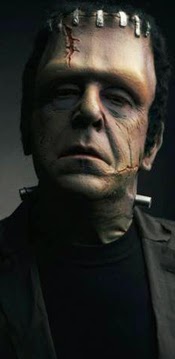
Thus reads the title of the cover story for the Turkish magazine, 46. The subject is rock/pop musician and composer, and film/TV actor Özkan Uğur, posing in an elaborate classic Frankenstein Monster makeup.

There’s a bit of a Glenn Strange vibe to Uğur’s Monster, don’t you think?

Instantly recognizable, truly iconic, the image speaks to the classic movie Frankenstein Monster’s universality. 

June 20, 2014

Eustace Frankenstein

Not an actual cover, Peter Emmerich’s illustration is a witty variation on The New Yorker’s colorfully named cover mascot, Eustace Tilley. 

Originally painted by art director Rea Irvin in 1925, adorning the magazine’s first issue, Eustace appeared as a glorified dandy, a high-hat in a high hat, with a high collar and a large coat with vast lapels. He peers blithely through a monocle at a butterfly, begging the question: Which of us is more ephemeral?

Through the years, Eustace has returned to the magazine’s cover, usually to celebrate its February anniversary. From the mid 90’s on, various artists have been commissioned to interpret the character in new and often wildly original ways. More recently, readers were invited to contribute their own takes in an annual “Your Eustace” contest.

Cartoonist and character designer Peter Emmerich submitted this Frankenstein variation in 2008, landing a spot as a Top Twenty finalist. The Monster’s expression is properly conceited as he gazes upon a flower, his high forehead a perfect substitute for Eustace’s stovepipe.

Peter Emmerich’s blog.
The New Yorker’s Flickr page for the 2008 Eustace Tilley Contest.
Mystery Man, a New Yorker article about Eustace Tilley, by Louis Menand.


Related:


March 22, 2013

Scary Monsters No. 85: Jack Pierce, Frankendesigner


Makeup legend Jack Pierce poses with some of his creations, including Monster and Bride, on this splendid wraparound cover for Scary Monsters Magazine by Terry Beatty.

In a busy field of horror film magazines, publisher/editor Dennis Druktenis’ Scary Monsters stands out as an engaging and uniquely fun title, a throwback to the “monsterfan” era down to its packaging, printed in black and white on cheap newsprint. Each hefty issue is crammed to the gills celebrating monster movies and the monster memories of Monster Kids. The eclectic offerings in the issue at hand include a meeting with the Black Lagoon’s Julie Adams, an article on the making of The Hideous Sun Demon, Charlton comics’ take on Reptilicus, and an entertaining look at mad scientist Boris Karloff’s pseudo-scientific wall scribblings from House of Frankenstein. And that’s not half of the content in this particular issue!

The cover feature is Larry (aka horror host Dr. Gangrene) Underwood’s defense of Jack Pierce as the true designer of the iconic movie Frankenstein Monster. In recent years, it’s been argued that others, and principally director James Whale, had considerable and even decisive influence on the character’s appearance. Underwood digs up and discusses a rich assortment of quotes pro and con. Underwood’s article is passionate and highly opinionated, leading to a perhaps foregone conclusion in Pierce’s favor, but the fun of the piece, and what makes it a great read, is that it is generous with quotes and references, allowing the reader to form his or her own conclusions. Another big plus is the complete text of a previously un-translated profile of Jack Pierce originally published in a Spanish-language newspaper.

Scary Monsters Magazine No. 85 is available directly from the publisher — come on, try a copy! — and Larry Underwood’s article, Jack Pierce, Frankendesigner is also available separately as an e-article for Kindle. 


Scary Monsters website.
Larry Underwood’s Dr. Gangrene blog

February 23, 2013

Bride Ballyhoo From The Vault


A haunting portrait of Boris Karloff as The Monster, painted by Daniel Horne, fronts the latest issue of Jim Clatterbaugh’s always excellent Monsters from the Vault magazine. The accompanying article, Ballyhoo and the Bride of Frankenstein, by John McElwee of the Greenbriar Picture Shows blog, is a gem.

Tracking box-office numbers, McElwee reveals how Bride and other classic horror films of the 30’s typically performed right out of the gate, often with record-setting receipts, but would fade fast, limiting engagements to a week, with few holdovers. Making a big splash on that first critical weekend required ballyhoo, the art of extravagant publicity, and the article is loaded with wonderful pictures of giant posters, character cutouts and live stunts that accompanied the film as it deployed across America in 1935. Here are the men in Frankenstein masks working the sidewalk crowds, the nurse booths in theater lobbies, mummy-wrapped dummies on gurneys, and ambulances parked out front. Newspapers ran a contest that had a lady sit alone through a midnight showing… “And When the Lights Go Up — If She’s Still There — A Crisp $5.00 Bill Is Her Reward!

The article also features pages from Universal’s exhibitor’s magazine showing examples of wild ballyhoo and “showmanship” stunts from around the nation.

Also in Monsters from the Vault No. 31, Greg Mank examines censorship issues with James Whale’s non-horror One More River (1934), actress Candace Hilligross looks back at Carnival of Souls (1962), and an article on Bela Lugosi and the making of Scared to Death (1947).

The issue is out now and you can order directly from the publisher.


September 21, 2012

Counting Down to Halloween


Well, Autumn is here and in a few more days, the roads of October will take us to Halloween. Kicking off the season in great style, Rue Morgue — consistently the best mass-market genre magazine — celebrates Universal’s centennial with a fantastic lineup that includes historian David J. Skal. On the cover, a fabulous bust of Boris as Frankenstein’s Monster by Toronto-based artist Justin Erickson.

Rue Morgue No. 127 will be available on newsstands and digital download on October first.

Boris, and Universal’s 100th are further celebrated next month as Turner Classic Movies host a special double-bill showing of Frankenstein (1931) and Bride of Frankenstein (1935) in selected theaters across America. This is a rare chance to see these classics on the big screen in sharp, remastered copies. The evening includes a recorded presentation by TCM stalwart Robert Osborne interviewing Sara Karloff, Bela Lugosi Jr. and makeup wizard Rick Baker.

The one-time TCM Frankenstein Event happens on October 24. Check the Fathom Events website for details, a list of theaters, and tickets.

And then, there’s Countdown to Halloween 2012 — hosted by the indefatigable team of John Rozum and Shawn Robare — where bloggers celebrate the spooky season every day, all month long. I’ll have a badge up on the menu that’ll take you to the Countdown site and, there, you can click through a long list of blogs and enjoy a boggling variety of Halloween-theme posts. There were over 250 participants last year! It’s great fun and a great way to discover new blogs.

I’ll be contributing to the Countdown with our companion blogs — Monster Crazy, Frankenstein Forever — and here on Frankensteinia, where I will be running another Frankenstein Book Month. I’ll be posting here every other day, reviewing Frankenstein-themed books and showcasing eye-popping Frankenstein graphic novels, including many NEW titles!

Join me, won’t you, for the Countdown to Halloween and Frankenstein Book Month, coming in ten days!


June 5, 2012

The Bride's Spring Wedding


The Bride stands for a wedding shroud fitting while her bewildered beau thumbs through a bridal fashion magazine in this whimsical cartoon by Tim Foley for Blown Covers, a friendly competition where artists come up with images in the very demanding style and spirit of those used on the cover of The New Yorker magazine.   

Run by The New Yorker’s art director extraordinaire, Françoise Mouly, Blown Covers was inspired by her book of the same name collecting outstanding but ultimately rejected covers for the magazine. Now, on a weekly blog, Mouly suggests themes and runs the best images submitted by artists from all over the world. The BRIDE image here was artist Foley’s submission on a recent “spring wedding” theme. A nice touch: Note the stitching in the color bar running up the side.

Tim Foley works in a startling variety of styles, equally at ease with painted portraits, caricature, scratchboard illustrations and elegant cartooning, as evident by the present image. There’s much to admire on the artist’s website and blog.


May 10, 2012

Alive, Alive!


Heads up! Artist Bernie Wrightson returns to Frankenstein, with scripts by horror-writer Steve Niles (30 Days of Night), in the new ongoing series Frankenstein Alive, Alive! arriving in comic shops this week.

First published in 1983, Wrightson’s astounding illustrations for Mary Shelley’s novel are legendary. Now, 30 years on, Wrightson is creating a sequel to the classic tale, in comic book form. The long-cherished project finally crystallized when Steve Niles came aboard as writer. The combined talents make Frankenstein Alive, Alive! an important, must-see addition to the Frankenstein canon.

Steve Niles has posted a fascinating conversation with Bernie Wrightson.


March 6, 2012

The Covers of Frankenstein : The Believer 2012 Film Issue


On the cover of the current, March-April issue of The Believer, artist Charles Burns likens movies to campfire tales, with Karloff’s Frankenstein Monster as the scare story being told.

In an extraordinary case of collaboration, Burns has illustrated every cover — 88 and counting — for The Believer, published by McSweeney’s. The artist’s love of classic monsters is evident is all his work, including his covers for the magazine’s annual Film Issue. Last year, Bela Lugosi’s Dracula appeared and the 2010 issue featured the dead martian from Hammer Films’ Five Million Years to Earth.

I blogged previously about Charles Burns. Click here to see his fabulous Frankenstein/Dracula group portrait and numerous links to his work.


The Believer magazine's 2012 Film Issue with excerpts from the featured articles.

The Believer 2012 Film issue order page.


With thanks to Kevin L. Ferguson.


November 29, 2011

Nino Carbé's Frankenstein


Much like the first Frankenstein play, in 1823, had spurred a new edition of Mary Shelley’s out of print novel, James Whale’s Frankenstein of 1931 brought the title back to prominence. The first books published in direct reaction to the film’s success were Grosset & Dunlap’s Photoplay Edition, featuring scenes from the movie and, in 1932, the Illustration Editions’ Frankenstein, with art by Nino Carbé (1909-1993).

The Italian-born Carbé was three years old when his parents immigrated to America, settling in Brooklyn. The boy’s artistic inclinations were encouraged and he proved something of a prodigy, studying the violin, drawing and painting, finally settling on the visual arts, enrolling at New York’s Cooper Union when he was 16. For a time, Carbé was mentored by master illustrator Willy Pogany, whose influence is palpable in Carbé’s Frankenstein. Pogany, by the way, worked briefly at Universal in Hollywood, painting a splendid poster for The Mummy (1932). Boris Karloff owned a Pogany drawing of himself in The Mummy’s Ardath Bey makeup.

Only 22 when took on Frankenstein, Carbé had already illustrated Tales of the Arabian Nights and Cyrano de Bergerac. Though he was clearly coming into his own as an artist, his Frankenstein pen and ink drawings evoke the elegant, elongated figures of Erté, the dark aesthetics of Audrey Beardsley, and Pogany’s dramatic illustrations for Tannhauser and Coleridge’s The Rime of the Ancient Mariner.

Striking operatic poses, Carbé’s emaciated Monster is very much the “deamon” of the book, with fangs, a droopy lip and pointy ears. A clear sign that the movies’ Monster had already made its mark, Carbé gave his Monster neck electrodes.

The superb jacket design, in black and green, features a curving title that may have inspired the logo used a decade later by Dick Briefer for his Frankenstein comic book.

Carbé would go on to a long career as a children’s book illustrator, punctuated by stints in animation. He worked for Walt Disney in the Forties, contributing designs and lavish background art to such titles as Fantasia, Bambi and Pinocchio. He returned to Hollywood in the Sixties for Disney’s The Jungle Book, eventually working for all the major cartoon studios. In 1982, Carbé returned to Frankenstein, adding new color art to his now classic black and white illustrations for a fiftieth anniversary Danish edition. He also produced a complex, limited-edition serigraph of the cover art.


A profile of Carbé and a large selection of his work are featured in a recent issue of Illustration, No. 34, that can be read online. See also Nino Carbé’s website.


Related:
Frankenstein 1931 Photoplay Edition


October 7, 2011

The Art of Frankenstein: Jim Warren


A striking portrait of The Monster in a pensive mood. The painting, by American artist Jim Warren, served as the cover to The Monster Wakes, a 1993 anthology of new stories on the Frankenstein theme, edited by Martin H. Greenberg.

It must be noted that Jim Warren’s soft-focus illustrations and portraits, as delicate as airbrushed art, are all painted with traditional brushes in oils on stretched canvas, attesting to the artist’s exquisite control of the medium.

Warren has painted over 200 book cover illustrations, many of them in the fantasy, science fiction and horror genres, as well as numerous album covers and film posters. He currently paints nature scenes and elaborate celebrity portraits.

A wide selection of Mr. Warren’s art is displayed on his website.


September 8, 2011

The Covers of Frankenstein : Routledge Edition, 1882


“His stature… seemed to exceed that of man… I perceived, as the shape came nearer (sight tremendous and abhorred!) that it was the wretch whom I had created.”

Frankenstein, seeking solace and solitude, retires to Chamonix and on to the remote Mer de glace, the Sea of Ice where, sight tremendous and abhorred, the thing he created appears and confronts him. The scene, with The Monster standing a full eight-feet tall as described in the novel, inspired the cover to this 1882 British edition, No. 159 of Routledge and Sons’ Sixpenny Series.

London bookseller George Routledge (1812-1888) began publishing in 1836, eventually founding the company that bears his name in 1851, the year Mary Shelley died. The imprint still operates today as a division of the Swiss publisher Informa.

A rare copy of this edition, from the Jerry Weist collection, is currently on offer through Heritage Auctions.


Related:
Mer de glace


August 26, 2011

Frankenstein Re-release Program Book, Austria 1957


Inimitable. Nobody ever wore the Frankenstein Monster makeup better than Boris Karloff, here on the cover of a 4-page program book for a 1957 Austrian re-release of the 1931 classic.

The inside spread features a selection of stills and a synopsis for the film. Credits list Colin Clive’s character as “Herbert v.” instead of Henry, and The Monster is tagged as “Das Ungeheuer”!

A curious back cover montage has The Monster and Little Maria playing the flower game in the cemetery where Clive and Dwight Frye dig for spare parts.


Via Heritage Auctions.


August 8, 2011

Announcing Monsterpalooza Magazine!

The Monster enjoys a little downtime in the dungeon, catching up on his pumpkin carving and getting a first look at Monsterpalooza Magazine, heading our way just in time for Halloween. The fabulous art is by Jeff Preston.

Otherwise independent, the new magazine shares its name and its love of monsters with Eliot Brodsky’s super convention held every spring in California. Monsterpalooza, the magazine, will be published and edited by Mark Redfield and Michael Heisler. The debut issue can be pre-ordered now through the Monsterpalooza Magazine website, launched today. Check the site for a list of eye-popping contents and contributor profiles. I’m delighted to report that I’ll be doing a piece celebrating the 80th Anniversary of Universal’s Frankenstein!


Monsterpalooza Magazine website and Facebook page.


August 1, 2011

The Covers of Frankenstein : Famous Monsters of Filmland No. 257


Here’s makeup wizard Rick Baker’s digital art cover for the new issue of Famous Monsters of Filmland, No. 257, celebrating the first anniversary since the venerable title rebooted.

Baker, who grew up on FM, pays homage with a portrait of Boris Karloff roped to his lab slab against the burning glow of the sulfur pit in 1939’s Son of Frankenstein, done in the vivid portrait style of artist Basil Gogos. Baker adds extra stitches and clamps to The Monster’s face, making this version both referential and original. Universal’s makeup genius, Jack Pierce, whom Baker acknowledges as a vital influence, would have approved.

This cover is one of three alternates. There’s a different newsstand cover, and another one for comic shops. Baker’s Frankenstein cover was offered at the recent San Diego Comicon. There are copies available directly from the publisher, but if you’re interested hurry up, quantities are very limited. The issue is also available as a digital download, with expanded content, including all three covers.

If it’s just the art you want, the Baker illustration is available as a limited edition print.


An interview with Rick Baker about his digital art, on Pixologic.


June 15, 2011

The Covers of Frankenstein : Hebdo September 1935


The Bride in proud profile on the cover of the Belgian Hebdo (“Weekly”) for Friday the 13th (!) of September, 1935. The orange and black duotone gives The Bride a plausible skin tone, lipstick and a nasty red scar.

The Bride was previously featured on the cover of Universal Weekly in March of ’35 (see here), but that was a studio publication meant exclusively for exhibitors. This wonderful find, courtesy of artist, collector and classic horror film expert George Chastain, appears to be the first mass-market magazine cover for Frankenstein’s Fiancée.

The long-running Hebdo featured movie news and reviews, entertainment, fashion and sports information, radio listings, as well as short stories and Otto Soglow’s Little King comic strip. This issue, running some 80 pages, carried a spread on Greta Garbo, photos of Clark Gable, Joan Crawford and opera star Grace Moore, a Science against Crime feature, an ad for Charlie Chan in Paris and short reviews of then current films Chu Chin Chow and Murder on a Honeymoon.

Here, the release of La Fiancée de Frankenstein is singled out as the week’s main event, with no corresponding feature inside. All the info is right there on the cover: A Universal film with Boris Karloff and Elsa Lanchester, playing at La Scala in Brussels. This electrifying image of a beautiful, swan-necked Bride, the world’s most unusual movie star, must have jumped off the newsstands. No extra ballyhoo was needed.

I previously posted a vintage newspaper ad for La fiancée at La Scala here.


With many thanks to George Chastain who wanted to share this rare, unique cover with Frankensteinia readers.


Related:
La fiancée de Frankenstein
The Covers of Frankenstein: Universal Weekly, March 1935
Friend? La fiancée de Frankenstein poster.


June 6, 2011

The Art of Frankenstein : Fernando Vicente


A wonderful likeness of Karloff’s Monster dominates this montage illustration of famous characters grouped on the March 2011 cover of the Spanish literary magazine Mercurio.

Artist Fernando Vicente is a superlative illustrator of books, CD covers and magazines. His books for children and young adults includes illustrations for J.M.Barrie’s Peter Pan. For adults, he has published a collection of his elegant pinup art. As a painter, he is perhaps best known his disquieting paintings of characters with their skin and muscle peeled back to reveal the precise anatomical features beneath.

Feast your eyes on Vicente’s art on his generous website. Navigation is easy even if you don’t speak Spanish. I also recommend his excellent blogs, devoted to different aspects of his art. The main blog, with links to the others, is here.

The March issue of Mercurio is available as a free PDF download.


May 7, 2011

The Art of Frankenstein : Joe Jusko


Doom is a heartbeat away even as Lon Chaney’s raging Wolf Man and Bela Lugosi’s superhumanly strong Monster leap at each other’s throats. In another instant, the castle tower, its mad lab and the battling twins of terror will be swept away by tons of churning water from an exploded dam.

The wild climactic battle from Frankenstein Meets the Wolf Man (1942), all to brief in screen time, is captured in spectacular detail by Joe Jusko for the cover of Famous Monsters of Filmland’s “retro” issue No. 71, coming to newsstands in September.

Joe Jusko’s dynamic cover introduces a classic FM feature, the novelization-like “Filmbook’ adaptation of Frankenstein Meets the Wolf Man, written by Martin Powell. The job is a dream come true for both Jusko and Powell, raised on FM and Universal Monsters. Jusko recalls being mesmerized by the Basil Gogos covers, and Powell is an avowed Frankenstein fan. Recently, Powell introduced Frankenstein themes in his scripts for The Spider comics and his graphic novel adaptation of Mary Shelley’s story, with art by Patrick Olliffe, has been continuously in print since 1989.

Joe Jusko’s meticulous and vivid paintings, laden with details, evoke the classic covers of the pulp and paperback era masters. His inspired art for the Marvel Masterpieces trading card series was credited with launching the trading card boom of the 1990s. In ‘95, a set of 125 paintings for the Art of Edgar Rice Burroughs cards made him the most prolific of all the Burroughs artists. Jusko has created countless covers and merchandising images for all the major comic book companies and a stellar cast of clients. His fully painted graphic novel, Tomb Raider: The Greatest Treasure of All, received a Certificate of Merit from the prestigious Society of Illustrators.


Joe Jusko's website.

Famous Monsters of Filmland website. You can pre-order FM #71.

Martin Powell talks about his Filmbook adaptation.


Related:
More Frankenstein Meets the Wolf Man covers:
Mad Monsters No. 5 and Famous Monsters No. 42,

Frankenstein: The Legend Retold, a guest post by Martin Powell.


October 27, 2010

Frankenstein: The Legend Retold
A Guest Post by Martin Powell


Above, the striking original cover art — sans overprinting — by artist Patrick Olliffe for Martin Powell’s adaptation of Frankenstein, first published in 1989.
I asked Martin to tell us how he came to Frankenstein, and how he came to write his celebrated graphic novel. Here’s what he had to say…

When I was a boy, visiting relatives in the country, I often sat in the dewy night grass and stared at the blackened woods, wondering what nameless monsters lurked and haunted behind the tangles of ivy and oak. My older brothers (and several imaginative cousins) were quick to impress such fanciful phantoms upon my youthful gullibility, and I was always eager to hear more, collecting each spooky story like other boys accumulated gum cards.

I suppose everyone has thrilled, at one time or another, to a ghost story, relishing a sense of ghoulish wonder at what really may be awaiting us in those darkened forests.
Mary Shelley certainly did.

Of all the classic authors, she’s certainly been the most influential to me, especially through Frankenstein, Or the Modern Prometheus. It has always seemed remarkable that Mary composed the greatest of horror stories while still in her teens. A very tough act, indeed, for any writer to follow.

The very first time I read the novel was a life-defining moment, changing me forever. I must have been about nine years old when I excitedly saw Frankenstein, as a paperback, on the top of my cousin Charlotte’s dresser. I’m sure I must have audibly gasped with astonishment. Charlotte kindly gave me that book, which I stared at during the entire long drive home, mesmerized by its enigmatic Karloffian cover. Already, I was hooked. I would read the book many times during the years to come, each time finding rich new layers that I had never dreamed of before, falling under its phantasmagoric spell again and again.

Ultimately, I was inspired to write my own graphic novel interpretation of Frankenstein. The powerful story had long haunted me, accumulating as a dream-project that was actually conceived when I was still in high school. My project proposal almost seemed to compose itself, and it’s more to Mary Shelley’s credit that my submission immediately found a publisher.

Next to Mary’s initial inspiration, it was the art of Patrick Olliffe, whom I was most fortunate in recruiting, which made the endeavor a success. It was perfect casting. Pat’s wonderfully moody and enigmatic black and white illustrations established a tangible atmosphere within a single panel. I remember having many lengthy, enjoyable phone conversations with him, in those days before the instant accessibility of the internet, as we planned our translation of Mary’s classic tale of terror. Early on I’d decided against stressing the popular “technology out of control” theme in favor of focusing on what I felt was the true soul of the story, that of an unwanted child.

In particular, I recall an in-depth discussion concerning what our Monster should look like. Pat and I obviously needed to avoid the famous design created by Jack Pierce, and owned by Universal Studios, and we relished the awesome possibilities that lay before us. This was a being, we reasoned, fashioned from the available raw materials of the late 18th century. Neck electrodes, square head, and over-sized boots suddenly seemed strangely out of place, even if they had been allowed.

Instead, Pat rendered a gnarled, towering, patch-work horror. His creature is wholly original, bringing Mary Shelley’s tantalizingly vague descriptions into the stark and terrible light. It is wondrous, pitiful, ghastly, and weirdly charismatic. For me, Patrick Olliffe’s visual depiction of the Frankenstein Monster is absolutely definitive.

Since its first publication in 1989, our Frankenstein graphic novel has never been out of print. Recently it was published again in a Spanish language version, and a brand new special edition looms in the near future.

That’s amazing and very gratifying.

Special thanks to Frankensteinia for inviting this warm remembrance, and to the gentle ghosts of Boris Karloff, Forrest J Ackerman, and Mary Shelley. I’d be nowhere without them.
— Martin Powell
October 24, 2010

Minnesota-based writer Martin Powell has hundreds of published credits for comic books and prose fiction. His Sherlock Holmes/Dracula graphic novel, Scarlet in Gaslight, was nominated for an Eisner Award. Earlier this month, his book, The Tall Tale of Paul Bunyan, illustrated by Aaron Blecha, won the Gold Medal in the graphic novel category of the Moonbeam Children’s Book Awards. Martin is currently scripting new adventures for such classic characters as The Phantom and the pulps’ The Spider for Moonstone Books.

Patrick Olliffe is an accomplished illustrator and comic book artist who has contributed to a who’s who of superhero characters, the likes of Spider-Man, Spider-Girl, The Atom, Superman, Batman and Wonder Woman, for Marvel and DC. He is now taking on The Mighty Samson for Dark Horse comics. Of his collaboration with Martin Powell on Frankenstein, he says, “Although early in my career, it remains one of the projects I love the most.


October 18, 2010

The Covers of Frankenstein : Daniel Clowes, Penguin (2007)


Launched by Londoner Allen Lane in 1935, Penguin Books turned the publishing world on its head with the new concept of making quality books widely available in inexpensive paperback editions, selling them not only in bookstores but off racks in tobacco shops, chain stores and train stations. The Penguin design, featuring strictly typographical covers color-coded for genre, was just as revolutionary. Fine-tuned, refreshed and reinvented through the years, Penguin packaging has remained a reference for high excellence in book design.

In one of Penguin’s most ambitious and imaginative cover projects, supervised over the last half-decade by American art director Paul Buckley, comic book and graphic novel artists such as Chris Ware, Charles Burns and Richard Sala were commissioned to create new covers for classic titles. In 2007, Daniel Clowes, of Ghost World fame, brought his unsettling, angst-filled comics style to Mary Shelley’s Frankenstein. It was a perfect fit.


The cover, couched in rain swept chiaroscuro, is the scene where Frankenstein, seeking solace in the Swiss Alps, encounters “the wretch, the filthy deamon” he has created. The scene continues on the front flap, done in a lighter cartoon style, but no less operatic, as Frankenstein curses his creation, only to be answered, “Have I not suffered enough that you seek to increase my misery?

The backcover shows a fearful Frankenstein returning to the garret he had fled from, abandoning his creation. It’s a surprising but excellent choice of scene, illustrating Frankenstein’s fragile state of mind.

The back flap is devoted to Mary Shelley, presenting, in six simple panels, a capsule recap of the book’s genesis at Villa Diodati, with a young Mary — “I’m only nineteen!” — awake in a moonlit bed, trying to come up with a story.


In a November 2007 interview with the Regina Leader-Post, Clowes revealed that he picked Frankenstein to illustrate after having an operation to repair a defective heart valve.

I felt a very great kinship with the poor fellow after my operation” Clowes said. “… my blood is finally pumping as it should, I feel totally reinvigorated and I have this ghastly Frankenstein scar that I can scare my son with."

Daniel Clowes’ cover for Frankenstein is certainly one of the most original and imaginative ever given the book.


Frankenstein, Penguin Classic Deluxe Edition (2007), with cover by Daniel Clowes.

An interview with Daniel Clowes from The Guardian.

An interview with designer Paul Buckley on The Casual Optimist.

Paul Buckley’s Flickr site.

A history of Penguin Books Design, on the British Design Museum site.