March 14, 2012

Shelley's Ghost in New York


An important exhibition celebrating the literary and cultural legacy of Percy Bysshe and Mary Shelley, and Mary’s parents, William Godwin and Mary Wollstonecraft, first presented at Oxford’s Bodleian Library a year ago, has come to North America. Shelley’s Ghost is presently showing until June 24 at the New York Public Library.

The exhibition includes letters, diaries, art and artifacts and, seen for the first time ever outside England, actual manuscript pages from Mary Shelley’s Frankenstein. A number of companion activities are scheduled, with more to be announced along the way.

There are a number of documents online: The NYPL’s exhibition page and companion website featuring numerous links, and an Illustrated Biography of Mary Shelley by Charles Cuykendall Carter and artist Derek Marks.

There is also an exhibition companion volume available from the Library’s bookshop.

I’ll be traveling to New York to see this later this spring, and I’ll report back.


Related:
Shelley's Ghost at the Bodleian

March 6, 2012

The Covers of Frankenstein : The Believer 2012 Film Issue


On the cover of the current, March-April issue of The Believer, artist Charles Burns likens movies to campfire tales, with Karloff’s Frankenstein Monster as the scare story being told.

In an extraordinary case of collaboration, Burns has illustrated every cover — 88 and counting — for The Believer, published by McSweeney’s. The artist’s love of classic monsters is evident is all his work, including his covers for the magazine’s annual Film Issue. Last year, Bela Lugosi’s Dracula appeared and the 2010 issue featured the dead martian from Hammer Films’ Five Million Years to Earth.

I blogged previously about Charles Burns. Click here to see his fabulous Frankenstein/Dracula group portrait and numerous links to his work.


The Believer magazine's 2012 Film Issue with excerpts from the featured articles.

The Believer 2012 Film issue order page.


With thanks to Kevin L. Ferguson.


March 4, 2012

Mike Mignola's World Horror Convention Poster


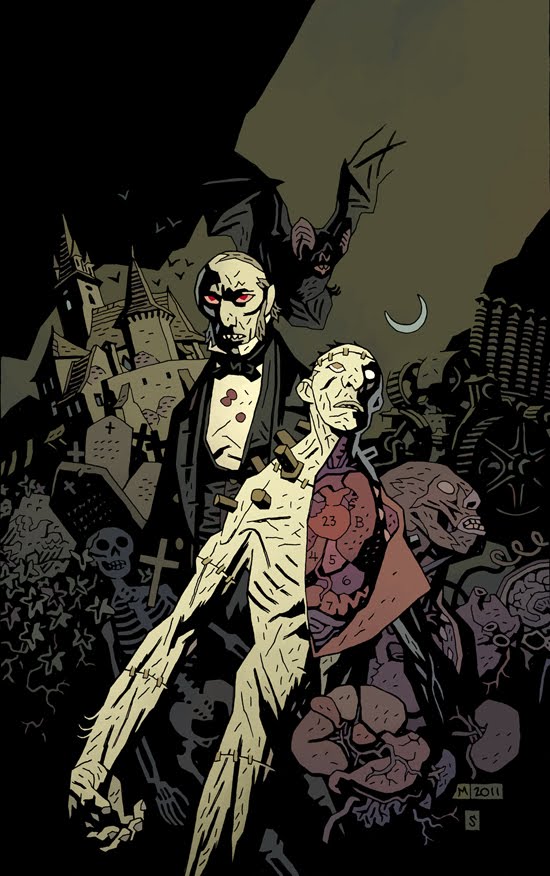
Always a thrill to find a new Frankenstein illustration by the great Mike Mignola. Here, under a dark crescent moon, a sawtooth Dracula and a flayed Monster pose amidst a rifled cemetery, a bat-haunted castle and a gearwork laboratory.

This image was produced for this year’s World Horror Convention, in Salt Lake City, March 29 to April 1, where Mignola is Artist Guest of Honor. A high quality poster print will be available, strictly limited to 100 copies and going for $100.

The World Horror Convention 2012
The Art of Mike Mignola

Related:
Hellboy Meets FrankensteinMike Mignola’s Bride of Frankenstein
Art of Frankenstein: Mike Mignola
The Covers of Frankenstein: The Frankenstein Dracula War
The Bride and the Betrothed

March 1, 2012

National Theater Frankenstein Encores


The UK’s National Theater has released a new trailer announcing encore screenings of its triumphant 2011 production of Frankenstein, written by Nick Dear and directed by Danny Boyle.

Despite universal acclaim, a stack of important awards and petitions by fans, the National has no plans to produce a DVD of the play, theater being, by definition, an ephemeral experience. Not to mention complex issues of performance rights. Still, this remarkable Frankenstein will be coming ‘round again this summer in a “limited season” of screenings through the NT Live circuit of movie houses around the world.

If you’ve seen this production, I suspect you might want to see it again, as I will. If you haven’t seen it, I urge you to do so. It’s as perfect a production of Frankenstein as anyone can hope for, brilliantly acted by Benedict Cumberbatch and Jonny Lee Miller, switching parts on alternate evenings as Victor Frankenstein and his Creature. There are many moments that have stuck indelibly with me, from the athletics of the creation scene under a canopy of over 3000 light bulbs, through the scenes with the blind DeLacey, Frankenstein haunted by little William’s ghost, the Creature’s harrowing encounter with Elizabeth, and a profoundly moving arctic finale. Best of all was a brief, poignant sequence where the Creature dances with his dream Bride.

Frankenstein will be screening this summer, beginning in June. The National Theatre’s Frankenstein page has a link to its NT Live venues. Whether all the venues listed will carry the encore performances is not specified. You might want to check with your local theater.


Related:
The National Theatre’s Frankenstein
The Reviews are In
Frankenstein Goes Global

February 28, 2012

Tonite... In Person!


Tracking the release, 80 years ago, of James Whale’s Frankenstein, we circle back to Los Angeles, where the film was made, with its triumphal premiere at the RKO Orpheum in January 1932. By then, in a zigzag course across America begun in November ’31, Frankenstein had snowballed into a major box-office hit. Boris Karloff was wrenched from relative obscurity as a busy character actor — Frankenstein was just one of 16 films he appeared in for 1931 — to be touted as a full-fledged movie star and “the successor of Lon Chaney”.

Karloff himself finally saw the film when he attended a showing with his wife and friends at Oakland’s Orpheum in late ’31. Shortly thereafter, his newfound fame was confirmed when the RKO circuit booked him into a series of personal appearances, climbing onstage between vaudeville acts to introduce his film. What a thrill it must have been to see the film when it was new, with Karloff in person, all for 25 cents.

RKO’s Los Angeles Orpheum, where the film house records, cranked up the ballyhoo, proclaiming, “Not since Los Angeles was a pueblo has it seen such a sensation!” and adding a late night Spook Show’s “Ghouls… Weird Noises… Strange Lights!”, turning the evening's program into “A two hour reign of terror!” The ads warned that no one would be seated during the final reel, and a notice of “No children’s prices” indicated that the film was unsuitable for the very young. Nurses, of course, were said to be in attendance.

L.A.’s Orpheum was a movie palace that dwarfed all others in size and extravagance yet, despite big-name vaudeville performers and record-breaking runs by Dracula, Cimarron and Frankenstein, the Great Depression hit hard and the house was shuttered for a spell at the end of 1932. It re-opened in ’33 with new owners and would stay in operation until 2000 when its screen went dark and the massive stage was converted for live entertainment. Today, the Orpheum is still a premiere showcase for musicals and touring artists. Its sumptuous interiors are available for film shoots, standing in for classic movie palaces in such films as Barton Fink, Ed Wood, and most recently, The Artist.


Orpheum Theater photo gallery

L.A. Orpheum Theater website


February 24, 2012

Frankensteinian : Vandoom's Monster


Frankenstein permeates popular culture and its themes have proven a fertile field for exploitation in comic books. A compelling example is the story at hand, Vandoom, the Man Who Made a Creature, written by Stan Lee, illustrated by Jack Kirby and inked by Dick Ayers, published in Tales to Astonish by Atlas/Marvel Comics in 1961. With a young Lee as editor and head writer, and a stable of experienced artists, the company was in the process of transforming from a low-end publisher into a comic book powerhouse. Tales to Astonish was one of the science fiction and horror anthology titles where Marvel’s superheroes — new ones like Spider-Man and reboots like Submariner, Human Torch and Captain America — would soon be introduced.

In a story that namechecks Frankenstein repeatedly, the action opens with the image of a Universal-style flattop Monster, a House of Horrors mannequin. The apocalyptically named Ludwig Vandoom, son of Heinrich, runs his late dad’s castle-based wax museum but, alas, the monsters of old no longer attract visitors — Never mind that the museum is located in a remote Transylvanian town. Ludwig, in a bid to revive the tourist trade, builds a new, improved Monster, “Ugly and frightening-- More so than any other monster! And it must be large—the largest wax figure in the world!

Writer Lee’s science fiction tales borrowed freely and frequently from classic monster movies and contemporary atom-age b-movies. He would acknowledge his debt to Frankenstein, mashed with Jekyll&Hyde, as inspiration for The Hulk. Artist Jack Kirby was also a fan of Frankenstein and the classic monsters, using them as inspiration or props in countless stories.

The Twilight Zone-type stories of Tales to Astonish, Tales of Suspense and Amazing Fantasy, invariably written by Lee, mostly illustrated by Kirby, Steve Ditko and Don Heck, typically featured giant monsters — scaly invading aliens, hairy ancient creatures reborn and insect-like things whipped up by mad scientists or provoked to life by natural catastrophe or supernatural intervention. Their names were memorable, like Kraa, The Unhuman! or Zzutak, the Thing That Shouldn’t Exist! and some of the stories were played as first person narrative: I Found the Impossible World! and I Am the Menace from Outer Space! The monsters had attitude, taunting crowds scrambling at their feet as “Foolish mortals!” and “Puny humans!”. A stranded alien who manifested as a pile of mud called Taboo, the Thing from the Murky Swamp crashed through downtown streets, arrogantly proclaiming, “All shall feel the wrath of Taboo! No one can withstand my onslaught!

In an amusing quirk of the genre, the giant monsters often wore pants. It may have been a case of the Comics Code cops frowning on the concept of barebutt monsters, but many of Kirby’s giant terrors sported boxing shorts or Mickey Mouse trunks. An enduring fan favorite, Fin Fang Foom was a horse-faced Chinese dragon who wore bright red Speedos.

In the end, deus ex machina kicked in and the monsters were foiled, fooled or felled by fate, or wily average Joes. A tree monster called Groot was invincible until termites got him. A paint-based creature called The Glop was destroyed by a can of turpentine. No kidding.

Vandoom goes to work, sculpting his masterpiece, building it so tall that he has to cut a hole in the roof to accommodate his monster’s noggin. No sooner is he done that a thunderstorm rolls in, lightning hits The Monster in the head — “a one-in-a-billion accident!” — and, without further explanation, the thing comes alive! Though Vandoom’s Monster is described as a wax figure, Kirby chose to draw him as a shaggy ape with a sabretooth underbite.

The animated statue breaks out of the castle and descends on the local village. In another swipe straight from the movies, the villagers, a superstitious bunch decked in funny hats and handlebar mustaches, take up pitchforks and torches. Then the story takes a sudden 90-degree turn when a funky spaceship appears and horned Martians pile out! “The earthlings are weak and ignorant!” the invaders say, “It will be child’s play to conquer them!


Vandoom runs to his rampaging Monster, imploring, “They’re MARTIANS! They are Earth’s enemies! They’ve come to conquer us! You must stop them! You MUST!” Some sort of animal understanding dawns on “the wax hulk” and The Monster plows into the Martian hordes. “My blaster is useless against him!” one invader complains. Another says, “A full charge of ultra-gamma rays… And STILL he lives!

Mauled Martian survivors hightail back to their ship and zoom away, their invasion plans cancelled on account of unexpected resistance. Weakened and wounded, the giant Monster collapses and dies. Grateful villagers arrange a burial and a monument for their savior, and pitch in to help Vandoom rebuild his Monster attraction from scratch.

In the last panel, Vandoom stands on the castle roof in a driving rainstorm, lightning crisscrossing the sky. “What if another bolt of lightning brings life to this one…

All the action in Vandoom, the Man Who Made a Creature clocked in at just 11 pages, plus 2 splash pages, making it the lead feature in Tales to Astonish No. 17. In the endless recycling common to comic books, Vandoom’s Monster would return, as suspected by Vandoom himself, in various guest-monster appearances.


February 21, 2012

The Posters of Frankenstein :
Spanish Abbott and Costello Meet Frankenstein


Abbott and Costello Meet the Ghosts was the Spanish title — as it was in the UK. In some countries, it was Abbott and Costello Meet the Monsters. In France, it was called Two Nitwits vs Frankenstein and in Germany, it was Mein Gott, Frankenstein.

Abbott and Costello Meet Frankenstein (1948) was the most influencial horror-comedy ever made, revolutionizing a genre occupied by haunted house spoofs and escaped gorilla farces, spawning an industry of local-comics-meet-classic-monsters copycat versions worldwide. The originals, Bud Abbott and Lou Costello, went on to Meet Universal’s Invisible Man and the Mummy, plus Boris Karloff playing Jekyll — Hyde was a stuntman — in one film, and a murderous fake swami in another.

The Spanish poster by Fernando Albericio shows the cartooned-up comedy duo pursued by a flying Dracula, the Wolf Man and a Frankenstein’s Monster with Karloff’s face instead of Glenn Strange’s. Albericio was prolific through the Fifties and Sixties, and comfortable in all genres.


A gallery of posters by Fernando Albericio.

Image source: Dr. Macro


Related:
Abbott and Costello Meet Frankenstein Knock Offs
The Legacy of Abbott and Costello Meet Frankenstein, by Frank Dietz
The Making of Abbott and Costello Meet Frankenstein


February 17, 2012

The Posters of Frankenstein :
Italian Frankenstein's Daughter


Here’s another Frankenstein poster by the great Sandro Simeoni. We’ve previously looked at his work for I Was a Teenage Frankenstein (1957) and The Revenge of Frankenstein (1958) — see the related links at the end of this post for images and a bio of the artist.

The square image in this vertical, insert-style poster for the Italian release of the sleazepit classic Frankenstein’s Daughter (1958) features the title monster at top, its crooked mouth expression replicating the face shown on American posters. In solid yellow at left is the Monster Girl seen in the film’s opening sequence.

The illustration is pretty simple and straightforward, yet it still show’s Simeoni’s trademark 3D effect, with a prominent character at the forefront and The Monster reaching out at the viewer with bared claws. And again, the freehand “Frankenstein” name is almost identical in design to the one used on Simeoni’s two other Frankenstein posters.

A list of 152 Sandro Simeoni movie posters. Click the highlighted numbers to see the images.


Related:
The Posters of Frankenstein: Italian I Was a Teenage Frankenstein (1957)
The Posters of Frankenstein: Italian The Revenge of Frankenstein (1958)


February 15, 2012

For Your Consideration

Nominations for the Tenth Annual Rondo Hatton Classic Horror Awards have been announced and I am thrilled and honored to have picked up two noms this year. The Rondos celebrate “the best in monster research, creativity and film preservation”.

Frankensteinia is up for Best Blog again, our fifth consecutive nomination. We won last year and I don’t know what the odds are of repeating, but I’d like to think 2011 was our best year yet.

I’m also up for a Rondo in the Best Article category for my piece celebrating the 80th Anniversary of Frankenstein, published in Monsterpalooza #1. It’s called Dare You See It? and it tracks how the film and its Monster percolated into the public consciousness through newspaper coverage and early ballyhoo. I’m delighted with this nomination as I’ve written and published a lot through the years, but this was my first magazine article in English. You can order Monsterpalooza direct from the publisher.

Congratulations and best of luck to all the nominees!


The Rondo Awards.


February 13, 2012

Uncanny Creature


Eighty years ago, James Whale’s Frankenstein rolled out across America and around the world. In April of ’32, the film landed in Western Australia — it would be banned elsewhere in the country — generating lots of press chatter. A stint at the Ambassadors Theatre, in Perth, yielded a heavy dose of exhibitor’s ballyhoo, such as this article published on April 16 in the weekly Mirror.

Obviously written by a press agent, the piece’s hype starts with a count of 1000 extras, a tenfold exaggeration, with director James Whale “adding an entire Tyrolean string band to the picture”. Another fabrication name-checks the late Lon Chaney as having “longed to play” the role of The Monster.

Considering the film’s eye-popping cast, it may appear curious to see a photo of the bland John Boles — as Frankenstein’s best friend and potential romantic rival — illustrating the piece but, lest we forget, Boles was a famous singing star and a Big Name attraction. The Monster, however, is clearly the film’s top draw: “This is one of the really astonishing things in the picture…” the piece reads, “This monster, with its semblance of HUMAN APPEARANCE, human gait and human actions, still gives a most overwhelming impression of the supernatural and mechanical motivation.” For all the hoopla, the article concludes with a line that was, in fact, closer to the truth than the writer ever imagined: “(The Monster) is probably the most uncanny creature that has ever stepped on the screen.”


The Mirror also carried an ad for a showing — “the powerful mystery of LIFE AND DEATH!” — at the Ambassadors, complete with the ad campaign’s two standard come-ons, “Dare You See It?” and “To have seen ‘Frankenstein’ is to wear a badge of courage.”

Frankenstein’s competition in Perth that week included Murder by the Clock (1931), a creepy mystery/horror yarn with Irving Pichel as a half-wit menace; The Beast of the City (1932), a notoriously violent gangster drama that helped put Jean Harlow over the top, and The Phantom of Paris, a Gaston Leroux mystery which, unlike Frankenstein as mentioned above, had actually been planned under the title Cheri-Bibi as a vehicle for Lon Chaney. What’s more, a Chaney film, the robust police drama While the City Sleeps (1928), was playing locally at the Hoyt’s Majestic in Fremantle, one of the last holdout theaters for silent films.

The Mirror, published on Sundays from 1921 to 1956, is remembered as Perth’s scandal-sheet, specializing in juicy gossip, high-profile sex and divorce cases, murders and the like.


Related:
A Premiere in Perth
At The Pictures: Frankenstein in Australia
Promoting The Bride: The Australian Frankenstein


February 9, 2012

The Posters of Frankenstein :
French Son of Frankenstein Re-release


Little Peter von Frankenstein (Donnie Dunagan) is hostage to his granddad’s rampaging Monster on this French 1970s re-release poster for Son of Frankenstein (1939). The photo, as it turns out, is a clever composite image.

The photo combines two stills from the film’s climax. The main image shows The Monster in action, hands blurred, with a guide rope cutting diagonally across his left shoulder and arm. The second image has Karloff’s Monster holding the child under one arm in a scene where he confronts Rathbone’s Frankenstein and Atwill’s Inspector Krogh.


The child and Karloff’s arm holding him were cut from one photo, then scaled and pasted onto the other. In pre-Photoshop days, the trick involved careful outlining of the characters in white gouache, painting out the background. The photos were cut, the pieces brought together, carefully aligned and re-photographed. Finally, probably using a Photo Retouch Kit — once standard equipment in a graphic artist’s tool kit — special gouaches were mixed to replicate the grays and blend the two images seamlessly. The background effect was either airbrushed or pencil tones, and the photo looks like it was screened for effect as it went to press.

In a career spanning five decades, artist and designer Xarrie (here credited as “Xarrié”) produced movie posters in a wide range of styles including caricature, classic painted scenes and photo manipulation. His genre contributions include posters for George Franju’s Judex (1963) and George Romero’s Night of the Living Dead (1968). He produced another strong photo-poster for the re-release of Island of Lost Souls (1933) by simply and very effectively applying a bright yellow to a Karl Struss publicity still.

With its austere design, its dominant, wholly original image and bold, straightforward typesetting, Xarrie’s Le Fils de Frankenstein is one of the more unconventional of all Frankenstein movie posters.


Photo Retouch Kit, image source.


February 6, 2012

Broadway's Infamous Frankenstein of 1981


Here’s Gilbert Lesser’s classic poster for the infamous 1981 Broadway production of Frankenstein, a show that opened and closed on the same day.

Written by Victor Gialanella, this adaptation first played to good reviews at the Repertory Theatre of St.Louis, in March and April of 1979. Translating to Broadway, the play acquired an extravagant budget and massive, state of the art sets, including a towering fuse-blower lab for the creation scene. The usual number of stagehands was tripled to 35 just to handle the set pieces rotating into view on a giant turntable or swinging in from the rafters. The show’s opening, set for December 1980, was bumped twice, first to allow fine-tuning of the complex special effects, and again when lead actor William Converse-Roberts, as Victor Frankenstein, was replaced by David Dukes. Other cast members included Dianne Wiest as Elizabeth and Keith Jochim, brought over from the St.Louis version, as The Creature. In an inspired bit of casting, the formidable John Carradine appeared as the Blind Hermit. Forty-five years earlier, he had played a bit part as a hunter who stumbled into the Blind Hermit’s cabin and beheld Karloff’s Monster in Bride of Frankenstein.

Problems multiplied and costs soared through rehearsals and over a run of 29 previews. When it finally premiered at The Palace on Sunday, January 4, 1981, the unanimously dire reviews dealt this Frankenstein the final blow.

The New York Times’ Frank Rich was suitably impressed by the spectacular effects, the overwhelming sets and director Tom Moore’s “sure pictorial sense”, but noted that actors “hardly register against all the smoke and fog.” The narrative, Rich opined, was “plodding”, “stilted” and “lead-footed”, merging scenes from James Whale’s 1931 film and Mary Shelley’s novel into “a talky, stilted mishmash that fails to capture either the gripping tone of the book or the humorous pleasure of the film.” Jochim’s Monster “learns to talk - and once he does, he refuses to shut upThough elaborately made up with the requisite cranial fissures, Mr. Jochim lacks a commanding physical or vocal presence. He's just a beery lout in a Halloween costume.Also singled out for criticism was the “B-movie musical score” with spooky organ riffs, “thrown on top of the show's other noise to announce the desired emotional effect of each scene.”

In the end, Rich noted, “We feel nothing except the disappointment that comes from witnessing an evening of misspent energy. ''Frankenstein'' may be the last word in contemporary theatrical technology, but its modern inventions are nothing without the alchemy of plain, old-fashioned drama.

Frankenstein was shuttered by dawn. Over the next 48 hours, desperate attempts were made to save the show. Cast members volunteered for pay cuts and creators waived their royalties. One plan called for investors to pony up an additional $400,000 for retooling and television commercials, but at two million and counting — four times the initial budget — Frankenstein was already the costliest of all Broadway failures, earning a permanent spot on top ten flop lists. On Wednesday, January 7, the show was officially cancelled.

Gilbert Lesser’s poster fared better. No sooner was it printed that it was snapped up by the Museum of Modern Art. "The show's folding notice wasn't even up yet,” Lesser recalled, “when the museum called to tell me the poster had been chosen for its permanent collection. It's the highest of honors."

Lesser (1935-19990) was a pure designer, working with geometrical shapes and typography to achieve rigorously sparse and stunning images. His theatrical contributions included a now famous poster for Equus using flat shapes like puzzle pieces for an image evoking Picasso’s Guernica. Lesser’s poster for The Elephant Man used the pictogram for ‘man’, skewing its limbs and replacing the dot on top with a large circle, suggesting the character’s misshapen head. For Frankenstein, Lesser took the original St.Louis poster — a monster’s white hand against a black background — to another level, using torn paper to assemble the jigsaw hand. Lesser was of a school of stark design with Saul Bass, and his Frankenstein poster recalls Bass’ posters and title sequences for Anatomy of a Murder (1959) and Bunny Lake is Missing (1965).

Victor Gialanella’s Frankenstein, in its original, pre-Broadway version, continues to be staged to this day. To be fair, the infamous Broadway version had been heavily rewritten. The author would go on to a brilliant career in television, earning two Daytime Emmy Awards for his work on Guiding Light and Days of Our Lives.


An appreciation of Gilbert Lesser, from The Baltimore Sun.

Frank Rich’s New York Times Review of Frankenstein (1981).

How Broadway’s Frankenstein nearly came back to life”.


February 2, 2012

Edison's Frankenstein: A Physicalogical Phantasy


A hundred and one years ago, when the first Frankenstein film came to Bemidji, Minnesota, the Majestic Theatre advertised it as “A Physicalogical Phantasy”. What that means is anybody’s guess.

The Majestic Theater, inaugurated in December 1909, was one of a new wave of movie houses that would replace the fast-fading storefront Nickelodeons. The local paper reported that, “Mr. Currie”, then manager, “has the very best movie-making machine that Edison has ever devised, and with his personal knowledge of every intricate movement of the machine, the results are indeed splendid.

The Frankenstein ad appeared on May 6, 1910, in the Daily Pioneer. On the same page, the Social and Personal column, a random collection of gossip, community news and product placement, ran a plug for the film as “one of the interesting and fascinating pictures ever thrown upon the screen. See it tonight…

The evening’s entertainment kicked off with a fancy Overture featuring Miss Hazel Fellows. A song, no doubt, accompanied by the pianist who would play through the evening, providing music for the films. Miss Fellows, a frequent performer at the Majestic, was probably local talent. By the following year, she’d changed her first name to Hazelle, which certainly sounded more artistique. I’d like to think that Miss Fellows provided some novelty, playing a banjo or the ukulele, maybe working in a few dance steps.

The Edison Kinetograph’s Frankenstein was up next. Shot on a Brooklyn rooftop just four months prior, the film went into circulation on May 18. Its stars, Charles Ogle, Augustus Phillips and Mary Fuller were Kinetograph regulars, miss Fuller on her way to silent-era stardom. The film has miraculously survived for us to judge, but what a thrill it must have been to see it when it was new, and pristine.

Next came an “illustrated song”, in which a popular song was either performed live or a recording played while a dozen or so glass slides were projected, “illustrating” the lyrics. The elaborately posed photographs, lavishly hand colored, bankrolled by sheet music vendors, were the music videos of the times. A vastly popular form of entertainment, some Nickelodeons played nothing but illustrated songs, with vaudeville performers and future film stars such as Fanny Brice, Eddie Cantor and Fatty Arbuckle appearing as models. Audiences would often demand repeat viewings. Sing-alongs were encouraged.

“I’m Going to Do What I Please”, written by music publisher Ted Snyder and lyricist Alfred Bryan was one of the most popular songs of its day. Snyder, a future songwriting Hall of Famer, also wrote The Sheik of Araby and Who’s Sorry Now?, and famously gave Irving Berlin his first break.

Rounding up the evening’s entertainment, “Another Of Those Thrilling Wild West Stories”, was The Girl and the Fugitive, starring Gilbert Anderson, the original Bronco Bill, the movie’s first cowboy star. Anderson had appeared, playing three different roles, in Edwin S. Porter’s seminal The Great Train Robbery (1903). He went on to write, direct, produce and star in his own movies. In 1907, he co-founded the famous Essanay Studios where he made some 300 short films, half of them westerns. The Girl and the Fugitive, released on March 9, 1910, was just one of the 44 Bronco Bill films made that year.

All told, the Majestic’s complete program ran about an hour. Not bad for ten cents. Children paid a nickel. I wonder if any kids were upset by Ogle’s scarecrow-like Frankenstein Monster.

And I wonder if anyone ever made out what a Physicalogical Phantasy was.


Related:
Watch the Edison Kinetoscope Frankenstein of 1910
The First Frankenstein of the Movies
After Frankenstein
A Weird, Fantastic Conception: Edison’s Frankenstein in New Zealand
The Silent Frankensteins


January 31, 2012

Frankenstein in Stitches


Several comments posted here, on Facebook and points between have noted how Primo Carnera’s Frankenstein makeup from 1957, revealed here last week, was very similar to that worn by Robert De Niro in Mary Shelley’s Frankenstein of 1994.

True enough. Bald and stitched cranium, sutured cheeks, upper lip and chin, and a damaged left eye. Very similar indeed, but Primo and Bobby were neither the first nor last of their monstrous kind.

Lon Chaney’s Monster for TV’s Tales of Tomorrow in 1952 heralded Carnera’s version with a baldhead and face-splitting stitch work. Springing 60 years ahead, the effect was revisited and worn by Jonny Lee Miller and Benedict Cumberbatch, sharing the part, in the celebrated British National Theater version of 2011. Call it same-school monster makeup.


Somewhat related, without facial distress, chrome-dome Monsters are known to sport ‘round the head, dotted line stitching indicating radical brain surgery. The two finest examples are — going from the ridiculous to the sublime — Cal Bolder in Jesse James Meets Frankenstein’s Daughter (1966) and Freddie Jones’s heart wrenching Creature in Frankenstein Must Be Destroyed (1969).

These Frankenstein Monsters are of a family. When opting for a baldhead look, similarities are perhaps inevitable. There are only so many ways to stitch a baseball.


Related:
Exclusive! The Monster: Primo Carnera
Exclusive! 1957 Frankenstein Makeup SessionRevealed!
TV’s Lost Frankenstein of 1957

Tales of Tomorrow: Frankenstein’s Notorious TV Adventure.


January 29, 2012

The Posters of Frankenstein : Constantin Belinsky


The Monster and attending Mad Scientists are blinded by the light of a glorious, luminescent Bride on this pastel poster by Constantin Belinsky (1904-1999) marking the release of Bride of Frankenstein in France, in 1935.

Belinsky arrived in Paris from his native Ukraine in 1925. He would come to share his time between commercial work as a movie poster artist and fine arts as an award-winning sculptor. His first poster was a vivid one-sheet for Scarface with a prominent credit for Boris Karloff. Though many of his posters were done in traditional oils, he was also known for his unique, modernistic posters with angular drawings and flat, vibrant colors.

After a wartime lull when his poster work fell way off — he managed to produce two elaborate posters for the 1943 Phantom of the Opera — Belinsky picked up again in the late Forties and became, through the next three decades, one of the most prolific movie poster artists in Europe. He would create art for the French release of such genre titles as The Incredible Shrinking Man, The Mole People, Creature from the Black Lagoon (and sequels), The Deadly Mantis, The Monolith Monsters, Monster on the Campus, Dinosaurus and Destroy All Monsters.

Belinsky also produced numerous posters for Sword and Sandal epics, Spaghetti Westerns and B-grade gangster movies, culminating in a series of Seventies Kung Fu action posters until his retirement in 1983. Along the way, he painted a number of Hammer Films posters, notably Dr. Jekyll and Sister Hyde, and classic exploitation work including Ricardo Freda’s The Specter of Dr. Hichcock (aka The Ghost) and Jean Rollin’s The Lake of the Living Dead/Zombie Lake.

Constantin Belinsky’s fabulous Fiancée poster is signed “C Belin”, a form he abandoned early in favor of “C Belinsky” or, more often, simple initials: “CB”. Film historian Christophe Blier published a book, Constantin Belinsky: 60 ans d’affiches de cinéma in 2000. Long out of print, it deserves to be reissued.


Related:
The Posters of Frankenstein


January 26, 2012

A FRANKENSTEINIA EXCLUSIVE!
The Monster : Primo Carnera

Always formidable looking to an opponent, former heavyweight champion Primo Carnera, 6 feet, 1 inch and 280 pounds, will scare the cold cream and curlers off the average housewife with his portrayal of Frankenstein.

Thus read the caption to this United Press Telephoto sent out to newspapers on February 2nd, 1957, promoting the February 5 broadcast of the NBC Matinee Theatre adaptation of Frankenstein. The presentation, the network insisted, “will not follow the movie as done by Boris Karloff but does follow the novel”.

The stunning image of Primo Carnera in full makeup was accompanied by a comparison photo of the smiling actor and suggested for use in tandem with a short news item by UP’s Aline Mosby. As an interesting side note, Mosby was the Los Angeles-based United Press reporter who famously revealed that Marilyn Monroe had posed for a nude calendar. She would become the first American female correspondent in Moscow where, in 1959, writing about American defectors, she interviewed one Lee Harvey Oswald. After the JFK assassination, Mosby’s recollections became part of the Warren Report. In Moscow, Mosby also interviewed the notorious Doctor Demikhov, the “real life Frankenstein” whose grafting experiments led to the creation of a two-headed dog. Mosby’s would go on to serve in Paris, London, Vienna and New York. In 1979, she opened the UPI’s first bureau in Beijing, China.

Primo Carnera’s acting career would remain a sideline to his athletic endeavors. A mere ten days after the Frankenstein broadcast, Carnera was in Sydney, Australia, where he drew a record crowd of 20,000 at the White City tennis stadium for a bout against Emile Czaja, nicknamed King Kong. The Vancouver Sun reported, “The match was declared no contest when both wrestlers fell out of the ring and Carnera began punching King Kong.

Carnera’s crazily stitched Frankenstein Monster stares dead-eyed back at us across 55 years, long gone but no longer forgotten, thanks to film archeologist George Chastain.


Related:
Exclusive! 1957 Frankenstein Makeup Session
Revealed! TV’s Lost Frankenstein of 1957


January 25, 2012

A FRANKENSTEINIA EXCLUSIVE!
1957 Frankenstein Makeup Session


Collector George Chastain does it again! Back in November, we posted a fabulous photo he’d uncovered of Primo Carnera’s wardrobe and makeup test for the February 1957 Frankenstein episode of NBC’s Matinee Theater. Now, new photos have surfaced and, again, Mr. Chastain is generously sharing them here with Frankensteinia readers.

The two AP wirepotos show boxer/wrestler turned actor Carnera submitting to makeup men for a January 30th dress rehearsal. The broadcast went out live from Burbank, California on February 5.

The photos show two stages of the application. First, Carnera is fitted with a skullcap and, later on, the full-face makeup is completed with textured skin and a network of crude stitches. Five artists were required to transform Carnera into The Monster, three of them seen in the photos. Walter Schenck and Edwin Butterworth would work together again, twenty years later, on the 1977 film version of The Island of Dr. Moreau. William “Bill” Morley was makeup man on the AIP TV special, The Wild Weird World of Dr. Goldfoot in 1965.

Matinee Theatre’s Frankenstein of 1957 is one of many lost programs from the early days of TV. These images, unseen for 55 years, are possibly the only remaining record of this historical broadcast.

But wait… There’s one more! Check this post for the most stunning portrait you are ever likely to see of Primo Carnera as Frankenstein’s Monster!


With thanks to George Chastain.


Related:
Revealed! TV’s Lost Frankenstein of 1957


January 22, 2012

The Great War Frankenstein


This editorial cartoon appeared on the front page of the original Washington Times — no relation to the current newspaper of that name — on May 12, 1918. The Kaiser figure in ceremonial uniform — “Afraid that the monster of his own creation will destroy him” — cowers from a looming giant wearing an eerie-looking gasmask, wielding a bomb, poison gas and “liquid fire”, a term describing gasoline or naphtha-spitting flamethrowers, sometimes mounted on airplanes.

The Frankenstein comment refers to Germany’s own attack strategies being used against it, The Monster effectively turning on its creator. “Germany is suggesting mutual cessation of air raids and gas attacks now that we have secured the ascendancy in both”. There would be six more months of horrific warfare until Armistice, in November.

The original Washington Times, first published in 1884, went through a succession of owners including, for a time, William Randolph Hearst. Eventually called The Washington-Times Herald, it was absorbed by The Washington Post in the 1950s.

The striking pen and ink drawing is signed, but I can’t make out the name. Can anybody ID the artist?

January 19, 2012

Nurses will be in attendance


Real live nurses and a real ambulance from nearby St.Joseph’s Hospital are ready to handle panicked patrons as Frankenstein comes to Parkersburg, West Virginia. It’s early 1932, with Holiday decorations still in evidence.

The nurse gag was a ballyhoo staple, arching back to the silent era and still in use as late as 1973 to promote The Exorcist. Stretchers, a waiting ambulance and girls in starched white costume patrolling the lobby with smelling salts were sure signs that the current feature was meant to wrack nerves.

Note the banner stretched under the marquee, spelling out the title in die-cut letters. It was offered through Universal’s Campaign Book to exhibitors as “A giant streamer to give your front and lobby that ‘Frankenstein’ flash!” It could be stretched “to fit any desired space… around the edge of the marquee, across the top of the main entrance, along lobby walls… Put them up wherever you need extra life in the lobby.

The streamer, made of extra-ply cardboard and printed in two colors, came strung with two wires and ready for hanging, all for $2.50. None of these wonderful banners appear to have survived.

The Smoot Theater was originally built for vaudeville in 1926 by the Smoot Amusement Company. Just four years on, it was bought by Warners and transformed into a Vitaphone/Movietone movie house, “comfortably cooled”. A simple brick building with terra cotta decorations on its façade, the typically lavish movie palace trappings were reserved for its interiors, notably some Tiffanesque hand-cut Austrian chandeliers, mahogany and brass doors, and gold gilding throughout. For a time, the Smoot was Parkersburg’s finest theatre. Movie stars and famous performers stopped over when swinging through the region. Guests included Rudolph Valentino, Guy Lombardo, Miss West Virginia and, in 1939, an visiting army of Munchkins, and two elephants.

Time and urban renewal caught up with the Smoot in 1986 when it was shuttered and marked for demolition, despite being listed on the American National Register of Historic Places. In 1989, literally two days before its scheduled extreme transformation into a parking lot, the theater was saved through community effort. Today, the grand old Smoot Theater is a vital showplace again.


The Smoot Theatre website, and page on Cinema Treasures.

Read about the remarkable Felice Jorgeson and her work keeping the Smoot Theater going.


January 18, 2012

This blacked out post is brought to you by SOPA and PIPA


Frankensteinia, Frankenstein Forever and Monster Crazy are on strike today.

Learn about the Stop Online Piracy Act and the Protect IP Act and how this legislation, if passed, would affect all of us, all over the world.

And do something about it.


January 16, 2012

The Frankenstein Clock


Released in November 1931, James Whale’s Frankenstein stepped across America and the world through the Holidays and into the New Year.

The Frankenstein Lobby Clock was a do-it-yourself promotional gag proposed by Universal’s publicity department. Exhibitors were told to paint a clock on a standup display, replace the twelve numbers with the twelve letters of "Frankenstein", add The Monster’s silhouetted head and fill in the number of days until the playdate. Copy should read, your choice, “Now is the time to think about Frankenstein coming here…” or “The Hour of Doom Approaches!

We’ll look at more Frankenstein ballyhoo in days and weeks to come as we continue to celebrate the 80th Anniversary of Frankenstein.


With thanks to John McElwee for this image. John runs the ever-fabulous Greenbriar Picture Shows movie blog.


January 12, 2012

The Posters of Frankenstein : Il Mostro di Frankenstein


There’s precious little material left attending the release of Il Mostro di Frankenstein, the lost Italian Frankenstein film of 1920. Here, recently surfaced, and predating a similar ad from 1926, is what becomes the earliest known poster of the film, for two showings in August 1922. Cheaply printed in two colors, these typographical posters were produced in low numbers for neighborhood distribution.

The “Frankenstein” name is misspelled, as it was, differently, on the 1926 poster. Producer/actor Luciano Albertini, an early Italian movie star known for his role as “Samson”, gets top billing.

An extraordinary film of sensational adventures”, the copy reads, “superbly interpreted by Albertini and his troupe”. The troupe in question included fellow strongman Umberto Guarracino, who played The Monster to Albertini’s Frankenstein. “A Masterpiece without precedent An enormous success”.

The accompanying film, La Caniglia — literally “the rabble”, and usually translated as “the gangster” — was another film from 1920, directed by and starring Enzo Longhi.

The long-lived Cinema Teatro Aurora opened in 1908 on the narrow Via Paolo Scarpi in downtown Milan. For a time, patrons could gather in an inner courtyard on warm days to be serenaded by the house orchestra. The Cinema switched to sound film in 1931 and underwent periodic upgrades through the years. After a season’s shutdown in 1980, the Teatro was revived as an adult movie house, operating briefly as the Aurora Pussycat. It closed definitely in 2003, after a remarkable 95-year run. The building is still standing, its façade intact, with the insides remodeled for commercial and cultural use.


Source: Wonderful research by film historian Giuseppe Rausa, notably a detailed account of the Cinema Teatro Aurora (in Italian), with links to numerous placard-type posters.


Related:
A placard from 1926 and a Belgian ad for Il Mostro di Frankenstein
The Silent Frankensteins


January 6, 2012

The Art of Frankenstein : Ben Templesmith


A nasty-looking, zippered, patched, stapled and stitched Monster created by Ben Templesmith.

The artist is best known for 30 Days of Night, penned by Steve Niles and turned into a 2007 movie. Templesmith’s other titles include Wormwood and Fell, all exclusively for IDW Publishing.


Ben Templesmith’s blog


January 5, 2012

The Art of Frankenstein : Tyler Crook


The Monster is a gentleman, never mind the ominous stare and the alarming forehead, in Tyler Crook’s handsome watercolor portrait.

Crook recently took over art chores on B.P.R.D., the superlative horror comic overseen by creator Mike Mignola and written by John Arcudi. Crook keeps a terrific blog where the image above was found. Go look, other Universal Monsters get the suit and tie treatment.


Tyler Crooke’s blog

Previews of Tyler Crook’s art for Dark Horse Comics


January 4, 2012

The Art of Frankenstein : Jill Thompson


Exceptional art by an exceptional artist, here’s a beautiful wash study of Boris Karloff from Son of Frankenstein by Jill Thompson.

The multiple-award-winning artist has worked for all the major comics companies, notably on titles such as Wonder Woman, Swamp Thing and Neil Gaiman’s Sandman at DC, and X-Men and Spiderman for Marvel. As a storyteller, Thompson’s Halloween-flavored Scary Godmother series has appeared in comics, children’s books and two animated films for television.


Jill Thompson’s Tumblr.

A 3-page sample of Scary Godmother.


January 3, 2012

The Art of Frankenstein : Mike Mignola


Let’s kick off the New Year with a handful of images, appearing daily this week, of the Frankenstein Monster as drawn by top comic book talent. First up, the master, Mike Mignola, whose simple, raw sketch captures Karloff’s soulful Monster with a bold black shape and a few essential lines. Typical of Mignola’s work, it is a beautifully designed piece, at once elegant and austere.

Visit Mike Mignola’s website, and explore Dark Horse Comics’ Hellboy Zone.