November 6, 2012

The Frankenstein Bookshelf


I think we agree, Frankenstein themes permeate popular culture and The Monster is an iconic presence. As further proof, if needed, these recent books…

For very young readers, The Monster’s Monster (Little, Brown & Company), by multiple award-winning writer and artist Patrick McDonnell, fields a friendly flat-top creature. “There’s nothing scary about him” reports the New York Times. “He’s actually quite endearing. His story is rather sweet.” The picture book blog 32 Pages says, “More Zen than Karloff, this Frankensteinian monster is the epitome of reverence, kindness and gratitude.”

Frankenstein, A Monstrous Parody (Feiwel & Friends), by “Ludworst Bemonster” (writer Rick Walton and artist Nathan Hale) is set in a creepy old castle where 12 ugly monsters reside. Frankenstein, we are told, is the ugliest of all!

The authors’ nom-de-plume and rhyming style are gentle jabs at Ludwig Bemelman’s classic Madeline books. The Washington Post reviewer promised readers they’d be “howling at the moon over this witty mash-up.”

For YA readers, Bekka Black’s iFrankenstein updates the Mary Shelley novel and formats the story as data transmitted by email, cellphone text, tweets and uploaded pics. Here, young Victor is a “computer nerd” and his Monster is a chatbot, a virtual creature who, like the classic flesh and blood Monster, escapes the control of his creator.

Appropriately, iFrankenstein is available exclusively as a digital download for Kindle and, soon, as an iPad App.


High on my list of must read books is Chris Priestley’s Mister Creecher, filling in previously unknown details of The Monster’s time in London and his friendship with a 15-year old street urchin. A writer of spooky tales and a damn fine illustrator, Priestley’s take on Frankenstein has been collecting all kinds of special mentions and award nominations. The Guardian called it “(an) ambitious novel… a stylish and atmospheric page-turner”.

Priestley keeps an excellent website and a fascinating blog. I’ll be returning to this tantalizing title soon as I get my hands on it.

Meanwhile, one more book review to come and we’ll wrap up our Frankenstein Book Month event. 

October 31, 2012

Shell Out! Shell Out! The Witches Are Out!


October has counted down and Halloween is here. Some pesky real-life obligations kept me from posting as much as I had planned to this month, but that’s ok, its Halloween every day here and my Frankenstein Book Month Event will spill into November and run a few more days.

The spooky season always brings heavy traffic to the site, for which I am grateful, and a link back posted on The A.V. Club sent my hits into the high stratosphere. Here’s hoping all you new visitors will come again! Most of all, I want to thank John Rozum and crew for pulling together well over 200 bloggers for Countdown to Halloween 2012. It was a hit from day one, and a hit for 31 days running! John, you bring Halloween to the web, and I dedicate the following to you…

Here, produced by the CBC (Canadian Broadcasting Corporation) is a fabulous 5-minute featurette on Halloween from 1954. You see kid decorating for the occasion, creating their own costumes and trick or treatin’ to the chant of Shell out! Shell out! The witches are out! I love the kid in the Frankenstein mask. I think he could be the first Monster Kid.

Click here for streaming video (and a 15-second commercial), and enjoy!

Happy Halloween!

October 23, 2012

Frankenstein, by Sergio Sierra and Meritxell Ribas


We could have Frankenstein Book Month with graphic novels only, considering the number of comics adaptations published worldwide. At hand is a Spanish version (in its French-language edition) by Sergio Sierra and Meritxell Ribas.


While rigorously faithful to Mary Shelley’s original, writer Sierra infuses Frankenstein with an intensely romantic and perfectly gothic sensitivity amplified by artist Ribas’ highly stylized scratchboards. There’s a bit of a Tim Burton vibe to the doll-like characters with their large heads, big eyes and tiny hands. The giant Monster, rendered with angular features and dead white eyes, is a formidable presence throughout.


The Barcelona-based Sierra and Ribas are frequent collaborators. Their Frankenstein was originally published in 2009 by Parramon Ediciones of Badamon, Spain, and Éditions Petit à Petit of Darnétal, France. Earlier this year, Meritxell Ribas illuminated a collection of classic vampire stories published by Mondadori, adding a startling red to her signature black and white scratchboard illustrations. 


Readers seeking this or any other foreign graphic novels I’ve mentioned this month might try Amazon or Abebooks. 


Sample pages from Sierra and Ribas’ Frankenstein

October 18, 2012

The Casebook of Victor Frankenstein, by Peter Akroyd


Using his formidable background as historian and biographer, Peter Akroyd retools Mary Shelley’s original as a realistic tale set mostly in London, with famous literary figures cast as a sort of repertory troupe for the novel’s characters. Percy Shelley is introduced as a fellow student to Victor Frankenstein, and Harriet Westbrook, Percy’s real-life abandoned wife, appears as Frankenstein’s fiancée, her drowning by suicide reimagined as murder by the Monster’s hand. Mary Shelley, Lord Byron and John Polidori, among others — including scientific figures of the time — are featured, and we get to visit the Villa Diodati in Geneva.

The Monster in this novel is a young man galvanized back to life at Frankenstein’s Thames-side laboratory, with ghastly results. Burned and deformed by the elaborate electrical installation, driven mad, the now dangerous creature escapes Frankenstein’s influence, thereafter to dog the experimenter’s every step with death and desolation, like an avenging ghost.

Akroyd brings Frankenstein’s era and the small, everyday details of the period to vivid, three-dimensional life. The author had me eagerly scurrying to dictionaries and Google to look up the no-longer familiar terms used for tradesmen, conveyances, food and drink. This is a generous book, a very compelling read, with a nasty twist at the end. Whatever you do, don’t even glance at the last few pages lest you spoil the surprise of the denouement, made all the more fun when you consider the clues that were sprinkled throughout the book.

The Casebook of Victor Frankenstein, published by Doubleday in America in 2008, is one of the very best of all alternate Frankenstein stories. A film version is reportedly in the works. 


October 15, 2012

Percy Shelley, by Casanave and Vandermeulen

Under a cover evoking William Powell Firth’s painting of their courtship at the Old Saint Pancras churchyard, here is the first of a two-volume French-language biography in graphic novel form of the Shelleys, Percy and Mary.

Book One, Percy Shelley, cuts to the chase, opening with Percy’s expulsion from Oxford in 1811 upon publication of his blasphemous pamphlet, The Necessity of Atheism.

Disinherited by his well-to-do father, Percy elopes with and marries Harriet Westbrook, embarking on a perilous life of perpetual flight, always racing to stay ahead of creditors.

When he grows unhappy with his marriage, Percy abandons his pregnant wife and elopes anew, this time with young Mary, daughter of Percy’s mentor, philosopher William Godwin. Percy and Mary had courted, meeting in secret at the grave of Mary’s mother, the famous and mutually admired Mary Wollstonecraft.

The book ends with Percy, Mary and Mary’s half-sister, Claire Clairmont, leaving the Godwin house hand in hand. “Come,” Percy says, “let us live our lives as if it were a novel!”


Writer David Vandermeulen crafts an honest portrait of Percy Shelley as a reckless idealist, arrogant and infinitely charming, strong in his opinions but frail in health. Vandermeulen’s works include a graphic novel biography of Fritz Haber, the father of chemical warfare.

Percy Shelley is beautifully rendered by Daniel Casanave’s nervous pen, with colors by Patrice Larcenet. Casanave has often mixed classic literature with the comics medium, illustrating stories by Apollinaire, Shakespeare and Kafka, Alfred Jarry’s Ubu Roi, and biographies of Baudelaire and Verlaine.

Percy Shelley, 76 pages, was published by Le Lombard of Brussels, February 2012. The followup book, Mary Shelley, was published in May. I’ll report on that one at a later date.


Read an 8-page sample of Percy Shelley (in French), and here are 11 pages from Mary Shelley. 


October 12, 2012

The Agonizing Resurrection of Victor Frankenstein and Other Gothic Stories, by Thomas Ligotti.

First published in a very limited edition back in 1994, a rare and prohibitively expensive collector’s item ever since, this notorious collection of vignettes — short-short stories averaging one page per tale — was revised and repackaged in 2011 by Centipede Press. Alas, the new edition sold out upon release and now commands very respectable prices itself.

Here, author Thomas Ligotti, a master of the short form story, explores classic horror with flash fiction pieces that extend oft-told tales, In a riveting and revelatory preface, Ligotti tells how the project began with The Island of Dr. Moreau, raising the question, “Why not take Well’s story, another step or two down the path of pain?”

As an example, Ligotti’s take on Frankenstein, The Agonizing Resurrection of Victor Frankenstein, Citizen of Geneva, reflects on the experimenter’s horror attending his own revival after his first death in the arctic.


Ligotti presents his book as a “museum of ever-echoing groans and endlessly twisting grimaces”. The stories here are so short, so tight, so vital, that often the titles themselves are essential to the narrative. Consider these examples: One Thousand Variations Performed Upon Diverse Creatures Undergoing the Treatment of Dr. Moreau, Humanist... The Excruciating Final Days of Dr Henry Jekyll, Englishman... The Heart of Count Dracula, Descendant of Attila, Scourge of God... The Insufferable Salvation of Lawrence Talbot the Wolfman... The Perilous Legacy of Emily St.Aubert, Inheritress of Udolpho... The Scream: From 1800 to the Present. There are several stories addressing Poe, such as The Interminable Residence of the Friends of the House of Usher, and Lovecraft, a frequent Ligotti reference: The Fabulous Alienation of the Outsider, Being of No Fixed Abode, and The Premature Death of H.P.Lovecraft, Oldest Man in New England.

The Centipede edition features the beautiful and disturbing art of Harry O. Morris, a regular Ligotti collaborator, who has also illustrated the works of Lovecraft, Clive Barker, and Stephen King. Slipcased and beautifully assembled, this collection is a gorgeous if expensive book. One can hope against hope that a more affordable version might be offered someday.


October 10, 2012

Galvanized!


We’re barely 10 days into the Countdown/Book Month Halloween event and I’m already running behind. Got lots of Frankenstein books on hand to share with you, not to mention that four more new books have arrived in the last few days! We’ll be well past Halloween before I can catch up with everything!

Case in point, I’ve just heard about Frankenstein Galvanized from David Saunderson, majordomo of the superlative Spooky Isles blog. The book, edited by Claire Bazin and just now published by Red Rattle Books under the direction of Howard Jackson, features the original 1818 text of Frankenstein — the 1831 revision is considered the “definitive” version — augmented with new essays on Mary Shelley, Gothic literature and the novel’s characters and themes.

I hope to get my hands on this one soon, and I’ll report back when I do. For now, I refer you to David Saunderson’s coverage. And while you’re visiting the Spooky Isles, you’ll want to get lost in the archives there, which include a number of Frankenstein-related posts.

So many books, so little time!

October 7, 2012

Monster, a Novel of Frankenstein, by Dave Zeltserman


I, Friedrich Hoffmann of Ingolstadt, am the very same abomination that Frankenstein brought forth into the world…

As the book opens, in rapid-fire succession, the young Friedrich Hoffman’s happy life is shattered as his beloved fiancée is murdered, he is framed for the crime, given a summary trial and sentenced to a horrific death upon the executioner’s wheel of torture. Death, begged for, finally descends… and then things gets worse.

Hoffman wakes anew, now a prisoner in a huge deformed body, a creation of mad science and ancient alchemy. Even as Hoffmann looks on, paralyzed, his new tormentor, Victor Frankenstein, slashes off and swaps his rotting body parts, sculpting the giant into its final shape. Hoffman’s atrocious new life begins.

Escaping from the demonic lab, fleeing the company of men as much as his own fate, The Monster encounters shape-shifters and devil worshippers in a whirlwind, headlong traverse of Europe, leading inexorably to Frankenstein’s mountaintop castle. There, finding himself a slave to his creator through a supernatural bond, The Monster is compelled to participate in unspeakably cruel and perverse activities for the amusement of the evil-hearted Frankenstein and his new partner, the Marquis de Sade!

Author Dave Zeltserman is best known for his hard-hitting noir crime novels. He approaches horror with the same take-no-prisoners attitude. Monster is a dark, harrowing tale steeped in grue, and an unrelentingly grim alternate take on Mary Shelley’s classic, as the man who is made Monster seeks revenge, while still desperately clinging to the last shreds of humanity within himself.

Monster, a Novel of Frankenstein by Dave Zeltserman, hardcover from Overlook Press, NYC, published August 2012.


Read the Prologue and Chapter One of Monster, courtesy of the author.

Dave Zeltserman’s website and blog.

October 4, 2012

Frankenstein, graphic novel by Denis Deprez


Written and painted by Belgian artist Denis Deprez, this French-language graphic novel, published by Casterman in 2003, is as much a literate adaptation of Frankenstein as it is a pure objet d’art.

The Monster's appearance here is obviously derived from the classic boxhead film version, otherwise author Deprez is very faithful to the original, allowing for compression and judicious tweaks as necessary to fit the novel into 60 illustrated pages. Like Mary Shelley, Deprez doesn’t dwell on the mechanics of the creation scene: Lightning attests to a stormy night, and The Monster’s eyes open. It’s a fine show of restraint where many artists would have stopped the story cold with a flashy display of lab fireworks. Instead, Deprez delivers a surprisingly intimate version of the famous story, dwelling on the emotions and inner thoughts of Frankenstein and his Monster.

Every panel a canvas, Deprez’ atmospheric art ranges from the sun-drenched scenes with the boy William that evoke the French impressionists, to dark, horrific moments like the tragic episode of The Monster’s mate, or The Monster’s fatal encounter with Elisabeth, done in a raw style reminiscent of Francis Bacon.

Denis Deprez also adapted Shakespeare’s Othello to the graphic novel format, as well as Melville’s Moby Dick, with writer Jean Rouaud, and a life of Rembrandt with his brother, Olivier Deprez.


Copies of Deprez’ Frankenstein can still be found through Amazon.com dealers, as well as Amazon.ca and Amazon.fr.

October 2, 2012

Frank'n'Stan, by M.P.Robertson

In this new picture book, Frank, a boy who longs to have a kid brother to play with, decides to build himself one. Blueprints are drawn, scrap metal parts are assembled and, with a click of its nose switch, Stan, the robot, comes alive.

Stan is Frank’s best friend and he even fits in as a family member, helping with household chores. Then, one day, Mom has a surprise for Frank: A new baby sister, named Mary. As little Mary grows, she gets all the attention and by the time she turns two, Stan the robot feels left out and, one night, he leaves.

Frank’n’Stan wears its Frankenstein references proudly. The boy’s name is Franklin P. Shelley, his sister is Mary. Frank finds parts at Byron’s junkyard, and there’s a copy of Frankenstein at his elbow, on his drafting table, when he draws up his plan. When Stan leaves, it’s winter, and Frank will travel through snow and storm to find and bring home his robot brother. The winter scene search for Stan clearly echoes Frankenstein’s arctic pursuit.

British writer and artist M.P.Robertson’s books for children include The Egg — it hatched a dragon! — and its sequels. Robertson works in a traditional, realistic style that suits this Frankenstein story to perfection, with lots of details drawn in for young readers (of all ages!) to pore over. Try spotting where the cat is on every page.

Frank’n’Stan is 32 pages, all in color. The black and white illustration shown here, a lovely Frankenstein reference, is from the end papers.


Frank’n’Stan by M.P.Robertson is aimed at readers 5 and up. It is published by Frances Lincoln Children’s Books.

September 28, 2012

Watch Horror Films... Keep America Strong!


Just in time and decidedly appropriate for Halloween viewing, here’s a new DVD celebrating the unique career of Northern California Horror Host Bob Wilkins.


Beginning in 1966 and appearing on three different stations over a span of 15 years, Wilkins logged over 1200 shows, screening some 1800 movies. No ghoul makeup here, no undertaker costumes, no Lugosi accent, Wilkins came on as himself, in a suit and tie, sitting in a rocking chair, wielding a cigar. Sometimes, with deadpan humor, he’d open with a list of what was playing on competing stations, urging viewers to switch over and spare themselves the grade-Z shocker he’d booked that evening. Ratings showed that fans stuck with Wilkins, abiding by the show’s motto: “Watch Horror Films… Keep America Strong!”

Strephon Taylor’s The Complete Bob Wilkins Creature Features is a scrapbook film, a rapid-fire smorgasbord of clips, intros and interviews from the shows, movie trailers and vintage commercials. The format makes for a very busy picture, split-screened throughout, clips competing for attention with a continuous supply of classic posters, and there’s even a crawl at the bottom listing every movie shown on Creature Features. The barrage of images can be a little overwhelming but, still, Wilkins’ personality, his easy charm and humor shine through.

For all the visual razzle-dazzle, clips of Wilkins’ guests will make you sit up and focus. There’s an encounter with John Belushi, a conversation with the irrepressible John Carradine, an interview with Blacula star William Marshall, and a fascinating exchange with Christopher Lee at a time when the actor had very publicly walked away from his Dracula and gothic horror parts and upgraded to a new Hollywood career. Best of all, there’s a wonderful 20-second clip of Boris Karloff doing a good-humored promotion for the show. The elderly Boris looks fit but, sadly, this may have been his last public appearance. He would pass away within a few short weeks.

The Complete Bob Wilkins Creature Feature is a rare and welcome glimpse at early TV, live and off the cuff, and a revealing portrait of a truly unique and engaging Horror Host. It’s pretty much essential fare for Monster Kids. Nicely packaged, the DVD is available — and only $15 — from November Fire.


September 21, 2012

Counting Down to Halloween


Well, Autumn is here and in a few more days, the roads of October will take us to Halloween. Kicking off the season in great style, Rue Morgue — consistently the best mass-market genre magazine — celebrates Universal’s centennial with a fantastic lineup that includes historian David J. Skal. On the cover, a fabulous bust of Boris as Frankenstein’s Monster by Toronto-based artist Justin Erickson.

Rue Morgue No. 127 will be available on newsstands and digital download on October first.

Boris, and Universal’s 100th are further celebrated next month as Turner Classic Movies host a special double-bill showing of Frankenstein (1931) and Bride of Frankenstein (1935) in selected theaters across America. This is a rare chance to see these classics on the big screen in sharp, remastered copies. The evening includes a recorded presentation by TCM stalwart Robert Osborne interviewing Sara Karloff, Bela Lugosi Jr. and makeup wizard Rick Baker.

The one-time TCM Frankenstein Event happens on October 24. Check the Fathom Events website for details, a list of theaters, and tickets.

And then, there’s Countdown to Halloween 2012 — hosted by the indefatigable team of John Rozum and Shawn Robare — where bloggers celebrate the spooky season every day, all month long. I’ll have a badge up on the menu that’ll take you to the Countdown site and, there, you can click through a long list of blogs and enjoy a boggling variety of Halloween-theme posts. There were over 250 participants last year! It’s great fun and a great way to discover new blogs.

I’ll be contributing to the Countdown with our companion blogs — Monster Crazy, Frankenstein Forever — and here on Frankensteinia, where I will be running another Frankenstein Book Month. I’ll be posting here every other day, reviewing Frankenstein-themed books and showcasing eye-popping Frankenstein graphic novels, including many NEW titles!

Join me, won’t you, for the Countdown to Halloween and Frankenstein Book Month, coming in ten days!


September 18, 2012

Lobster Johnson Meets Frankenstein

Mike Mignola’s lanky, bolt-studded Frankenstein Monster appears on an alternate cover for Lobster Johnson: Caput Mortuum. The illustration is one of the artist's “Year of Monsters” series matching Hellboy universe characters with classic monsters. 

Lobster Johnson is Mignola’s take on 30’s pulp heroes, a goggled, leather-jacketed vigilante battling mobsters and monsters, and branding their foreheads with his claw emblem. Though the character died in 1939, his ghost continues his crusade against supernatural evil.

Caput Mortuum, a one-shot comic book, is written by Mignola and John Arcudi — a team that consistently turns out some of the best horror comics published today — with art by Tonci Zonjic. Note that the Mignola covers for this are somewhat rare, as an alternate offering to the regular covers by Zonjic. The issue hits comic book shops this week.


A 3-page preview of Caput Mortuum.
The regular cover by Tonci Zonjic

September 13, 2012

The Art of Frankenstein : Brian Ewing


A literal icon, this aureoled Bride evokes the stylized painted images of historical religious culture. The stunning poster was created by New York-based artist Brian Ewing. The artist first visited with Frankenstein and Bride back in 1997 for Electric Frankenstein.

Best known for his band posters — this one for Swans —  Ewing’s work now spills into all aspects of packaging and merchandising, and fine arts. Check out Ewing’s terrific portfolio and a fascinating tutorial revealing the artist’s meticulous methods.


Brian Ewing’s website.

September 7, 2012

Found! Frankenstein inscribed by Mary Shelley to Lord Byron!


A true treasure has come to light: A rare, first edition copy of Mary Shelley’s Frankenstein; or, the Modern Prometheus, inscribed “To Lord Byron from the author”.

The book was among the possessions of Baron Jay (1907-1996), a British politician and one time President of the Board of Trade. The discovery was made by the Baron’s grandson, bibliophile Sammy Jay. Although Mary Shelley did not sign her name, her writing has been verified by an expert of the Bodleian Library at the University of Oxford, where Mary’s manuscript pages of Frankenstein are kept.

It was Lord Byron who, in the summer of 1816, invited the Shelleys to join him at Villa Diodati on Lake Geneva, and it was Byron who proposed a friendly competition, to come up with ghost stories. Mary’s idea grew into the novel, Frankenstein, and published on New Year’s Day, 1818. The copy at hand is one of only six copies given Mary by her publisher. Inscribed, it was mailed to Byron by Mary’s husband, Percy Bysshe Shelley. Lord Byron once recommended the book to a friend, saying, “Methinks it is a wonderful work of a girl of nineteen — not nineteen indeed — at the time”.

First edition copies of Frankenstein are rare and can fetch upwards of $100,000. Until now, only one other signed copy was known to exist, and although this new find is incomplete — originally published as three slim books, here, only the first volume has survived — it was inscribed to and once owned by Lord Byron who, as it were, attended the birth of Frankenstein. Given the remarkable provenance, this unique copy is estimated to be worth over £400,000 (roughly US$635,000).

The book will be displayed for one week, beginning September 26, at Peter Harrington’s of Chelsea, London, one of the world’s leading rare book dealers.


Read more about Lord Byron’s copy of Mary Shelley’s Frankenstein on the Peter Harrington website.

September 4, 2012

Mary Shelley, by Cailey Tervo


Cailey Tervo describes herself as “a young artist doing her best to do better”. Judging from this portrait of Mary Shelley, captured in a few lines and muted colors, Ms Tervo is well on her way to great things.

The image is one of a digital sketchbook series called Fearsome Ladies. It was originally posted last week, on August 30, Mary’s 215th birthday. 


Cailey Tervo’s portfolio and blog.

August 31, 2012

Frankenstein Fashions


“Don’t underestimate the value of your screen fashions” advised Photoplay magazine, in December 1931. “You can go back home with a wealth of ideas for pepping up your own clothes picture.”

As an unusual and subtle way to plug their hot new horror film, Frankenstein, just then rolling out across America, Universal entertained Photoplay magazine’s young women readers with pictures of Mae Clarke, the film’s Elizabeth, modeling screen-worn fashions.

Published under the title Stars Broaden Shoulder Lines, the first photo shows Clarke in the fur collar dress — “Worn in Frankenstein” — from scenes where she and Victor recruit Dr. Waldman and travel through a storm to the tower laboratory where her fiancé, Henry Frankenstein, treats them to a lightning show and the first stirrings of his slab-bound Monster.

The second photo shows Clarke in a light wool crepe number accessorized with a “vest-like arrangement” of baronduki, a fancy name for the Siberian squirrel. This is the dress she wore in the scene where Elizabeth returns to the lab, this time with Henry’s pompous father, only to find her beloved in a state of nervous collapse. “See this in Frankenstein” reads the copy.

The studio, or perhaps the magazine editors, chose to show Clarke in smart street clothes, something readers could aspire to. In the film, Clarke also appears in a very chic lace dress and, of course, a spectacular wedding gown with an endless train.


August 27, 2012

Frankenstein Gossip in Photoplay

Launched in 1911, Photoplay was the number one movie fan magazine for most of its 78 year run. Its contributors included some of the most famous film reporters ever assembled, notably Adele Rogers St. John, Dorothy Kilgallen, Walter Winchell, and competing gossip queens Hedda Hopper and Louella Parsons. The magazine’s most prolific correspondent was one Cal York, introduced in 1916 and still active when the magazine folded in 1989.

Here, two items from Cal York’s Monthly Broadcast From Hollywood column marked the genesis of Frankenstein, when Bela Lugosi was cast as The Monster, and the release of the finished film, with substitute Boris Karloff.

From the August 1931 issue, a short item hails Lugosi as the new Lon Chaney, fresh from Dracula and now slated to play “the unborn man” in Frankenstein. The Monster would be eight feet tall, with only the actor’s chin and eyebrows poking through the makeup.

Jumping to December 1931, Cal York’s column carries an anecdote about set visitors, namechecks director James Whale, and reports that Boris Karloff toiled under 48 pounds of makeup and “body structure”, causing him to lose 21 pounds.

If the items read like studio-fed publicity, guess what. “Cal York” was a house name (CALifornia – New YORK) serving an ever-changing staff of contributors, and the monthly “Broadcast from Hollywood” column was a collection of tidbits gleaned from studio PR. Of Frankenstein’s makeup torture, contemporary newspapers carried the same stories, often augmented to include Lugosi’s monster face improbably melting in sunlight and Karloff given leg braces and an inexplicable steel spine, creating his mechanical gait. The story about wearing a veil to and from the set was substantiated with obviously posed photographs of Karloff, head covered, led around by makeup man Jack Pierce.

The hype was fanciful, sometimes outrageous, and always entertaining. Finding factual information within these stories is much like panning for elusive gold.

Next up: Universal targets Photoplay’s young female readers with Frankenstein fashions!

Cal York info from Andrew Slide’s book Inside the Hollywood Fan Magazine (University Press of Mississippi, 2010).


August 23, 2012

Photoplay Frankenstein


Boris The Monster makes an unlikely appearance in the November 1931 issue of Photoplay, the leading movie fan magazine of its time, where picture space was usually reserved for Hollywood’s most glamorous stars.

In stunning profile, likely shot by Universal still photographer Roman Freulich, Karloff’s face shines through the heavy makeup. Perhaps the photograph was taken before final touches were applied, or it was lit in such a way as to wash out the dark paint that gave The Monster its dead-man gauntness of thin black lips, sunken cheeks and dark circles under the eyes.

Note that we see Karloff’s forehead, perhaps treated with greasepaint or thin gauze. Note the brow ridge and the crown, built up separately. With The Monster’s next outing, for Bride of Frankenstein in 1935, makeup man Jack Pierce would use a one-piece, full forehead rubber appliance that simplified and sped up application. Note also, that Karloff doesn’t appear to be wearing the heavy eyelids that gave The Monster its menacing, lizard-like stare. The story goes that Karloff himself suggested the droopy lids, to dull The Monster’s eyes. Here, the eyes are bright and intelligent.

Photoplay was launched in 1911 as a film-related fiction magazine, soon to embrace the nascent Star System and quickly evolving into a massively influential film celebrity magazine, reigning at the peak of Hollywood’s Golden Age. With a writing staff that included the nation’s top gossip columnists, Photoplay typically featured profiles of big name performers, with heavy emphasis on their romantic liaisons, as well as movie star fashions and beauty tips.

The issue at hand featured comedienne Ina Claire on the cover, painted by F. Earl Christy. A cover blurb warned, Don’t Go Platinum Blonde Yet! Wait!. Articles included The Extra-Private Life of Marlene Dietrich, Why Women Go Crazy About Clark Gable, and a profile of firebrand “Loop-de-Lupe Velez”. Though the magazine acknowledged the popularity of chillers, horror films got very little coverage in Photoplay, too grim a subject for its glamour-seeking readers. It speaks to Frankenstein’s novelty and box-office clout that the film won some degree of attention from the nation’s best-selling movie magazine.

Stick around, we’ll look at more Frankenstein references from Photoplay over the next couple of posts. 


Related:Frankenstein Gossip in Photoplay

August 20, 2012

Frankensteinia is Five


And all of a sudden, this blog is five years old!

I’d like to take a moment, before the day runs out, to mark the occasion. Frankensteinia launched on August 20, 2007. Over these last 5 years, we’ve made 750 posts and recorded more than 930,000 hits. By year’s end, we’ll go over one million visitors. Combining average daily hits with our subscribers on Google Reader, Facebook and Twitter, we boast some 4,000 regular followers. These numbers boggle my brains.

In 5 years, we’ve garnered 7 Rondo Award nominations in 3 different categories, good for several Honorable Mentions, a couple of Runner-Ups and, of course, a beautiful Rondo for Best Blog, in 2010. In the schorlarly world, Frankensteinia has been recognized as a resource by Intute, a consortium of seven British universities; the Museum of London, and consulted by the New York Public Library.

Looking back, I’m proudest of our “discoveries”, little facts — and big ones — and new information we’ve uncovered. This year alone, we revealed never-before-seen photos of Primo Carnera’s Monster from a 1957 television play (here and here). I’m proud of our Silent Frankenstein series where we found tons of new information about Life Without Soul (1915), and a photograph of Il Mostro, from the Italian Frankenstein of 1920. Most fun was finding an explanation for the curious, branch-like hands of Edison’s Frankenstein of 1910. It seems The Monster's hands came… from Mars! Go Look!

Now, autumn looms and posting here will pick up, as it must, during our busiest season. I’ve got a lot of new and fun material, ready to go. I have piles of Frankenstein books, many new ones, to review, and new discoveries to share. Over the next few weeks, I’ll be revealing a lost Frankenstein film appearance from the Thirties (!), and startling new information about Mary Shelley’s very inspiration (!!!).

As we begin our 6th year, I want to thank you, all who visit, and especially you regulars. You know who you are. You keep me going.

Enjoy.


Photo at top shows Boris Karloff celebrating a 1938 birthday on the set of Son of Frankenstein (1939). Later, the same day, Boris would celebrate again when news came that a daughter, Sara, was born.

August 17, 2012

The Line Starts Here


Spotted on the Zombos’ Closet blog, this remarkable photo showing patrons crowding the lobby and trailing out to the street, waiting to see Frankenstein (1931) on its first run. The anticipation is palpable. Soon as the usher drops the velvet rope, you know there’s going to be a scramble for the best seats in the house.

Oh, to have seen Frankenstein back then. Today, the film’s themes and design have been sampled to the point of becoming clichés, and The Monster is a universal icon. We can only imagine how perfectly thrilling it must have been when the film was new.  
There’s no provenance given here, this could be any theater in the English-speaking world. Note the fabulous and very rare “graverobber” poster. I don’t know of any of these that have survived. I’ve only seen this image before on a Swedish poster and as a line drawing used in newspaper ads. 
Zombos’ Closet, operated by John Cozzoli, is a superlative blog devoted to the celebration of horror in popular culture. It touches everything from Halloween and B-Movies to discussions on horror fiction and serious studies of the genre. It is also a wonderful resource for images. Case in point, check out this recent posting of the complete, original 1942 pressbook for The Ghost of Frankenstein.
With thanks to John Cozzoli. 

August 12, 2012

The Art of Frankenstein : Shichigoro


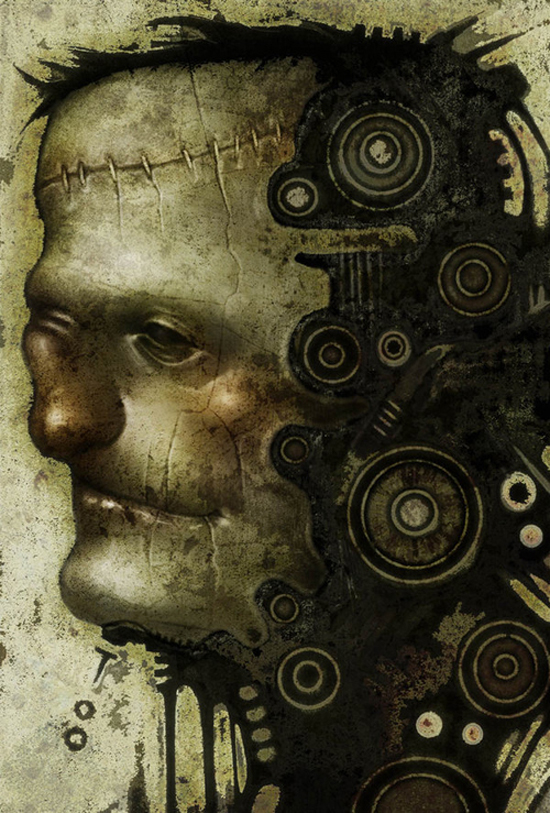
Yokohama-based Shingo Matsunuma, otherwise known as Shichigoro, brings the light of fantasy into the dark world of gothic art. Somehow, his man-machine hybrids, robot fish and transformed animals always fascinate without ever being truly disturbing. “In my world,” Shichigoro says, “there is no fear; no fear of creatures, no fear of machines”.

Shichigoro’s Frankenstein Monster is an impressive steampunk creation, an extreme amalgam of flesh and metal but, still, he is a stoic, patient creature, and you will note the hint of a smile on his cracked lips.

Shichigoro keeps a fine website filled with wonderful art. The artist’s quote is from an article in Walking Blind magazine.

August 9, 2012

The Bride Alive


She’s only onscreen a brisk, fleeting twelve minutes yet, 77 years on, The Bride of Frankenstein is instantly and universally recognized, an indelible icon. Artists and photographers have paid homage, often improvising and reinventing the character, sometimes to excess.

I love the direct reference, the simple straightforward photograph here, by Ben Albares of Malaga in Andalusia, Spain. The model, Jera Strucc, looks like a young Elsa Lanchester. This is The Bride captured as she was.


And speaking of The Bride, last October, cartoonist Thomas Boatwright celebrated Halloween with a sketch-a-day project sampling James Whale’s Bride of Frankenstein in 31 rough and robust digital drawings, which I blogged about here.

Now, Boatwright has collected his Bride series as a very limited edition and inexpensive art book, shipping in September. Hurry up if you want one, there are only 31 copies!


August 6, 2012

Frankenstein in Brisbane, Part 5:
Sit Up and Take Notice

The Monster in dramatic silhouette dares Brisbanians to see Frankenstein, June 1932. They responded in droves.

As the film played its weeklong engagement at the Tivoli, the management kept the ballyhoo on high, running a different newspaper ad every day. Another oft-used slogan for the film, The Monster is Loose!, accompanies a photo of Mae Clarke's bedside swoon. 

Frankenstein was pronounced “The picture that is making Brisbane sit up and take notice” and, indeed, its showing at the Tivoli was immediately followed by a stint at the Majestic, and then on to a third week at the Valley.

Opened in 1915 as a Vaudeville house, the Tivoli was a unique twin theater. The lavish, main auditorium held 1800 seats and the Roof Garden sat another 1200. The cold air plant inside and the roof theater's large awning with open sides made the Tivoli “the Coolest Theater in Australasia”. Repurposed in 1927 as a cinema, the Tivoli was then billed as “Brisbane’s Most Popular Talkie House”. It would fall to urban renewal in the late Sixties.

By the time Frankenstein played Brisbane, the film was already a top box-office draw. As we’ve seen over this series of posts, the PR people at the Tivoli, with bold ads and even an in-person Frankenstein appearance, made sure that everyone knew that The Monster was in town.

In weeks to come, we’ll visit other towns and enterprising theaters all over the world where Frankenstein was rolled out in style.