June 30, 2012

Faux Frankenstein


Artist Jason Edmiston turns in a stunning poster for a movie that never was.

Farm of Frankenstein is one of several faux films in a fun, fictional If They Came from Within: An Alternative History of Canadian Horror Movies, a collection of movies “that didn't get made, couldn't get made and maybe even shouldn't get made... but we'd love to see nonetheless.” The exhibition, curated by Dave Alexander, editor-in-chief of Rue Morgue magazine, premieres at the Fantasia Film Festival on July 20 and runs until the 29th at the prestigious Cinémathèque Québécoise in Montreal.

A who’s who of Canadian and Québécois writers, artists and designers are contributing to this unusual art project, with plans to grow the exhibition as it travels to other cities, adding soundtrack recordings, promotional stills, props and trailers. Hopefully, the project will yield a companion book.


If They Came from Within Facebook page.
Montreal’s Fantasia Festival (July 19-August 7, 2012)
Rue Morgue magazine.


June 16, 2012

The Art of Frankenstein : Patrick Jones


A bold composition and a steampunk sensibility are highlights of Patrick Jones’ spectacular, insanely detailed creation scene.

Born in Belfast, trained in London and now working out of Brisbane, Australia, Patrick Jones, influenced by Frank Frazetta and Richard Corben, has earned the admiration of fans and peers the likes of Julie Bell and Boris Vallejo. Jones shares his immense talent for science fiction, fantasy and horror art through books and videos detailing his techniques.

The Frankenstein painting is offered from the artist’s webshop as a limited edition Giclee print.


Patrick Jones’ website and blog.

An interview and step-by-step demonstration illustrating Richard Matheson’s I Am Legend, on bare•bones.

June 12, 2012

Death Interrupted


This is not a Frankenstein book but, hey, zombies are family. At their most basic expression, The Monster and the zombie share provenance as revenants and symbols of death defiled, cursed with life.

From the heady golden age of horror comics, these collected tales celebrate zombies — old school, please — the kind yanked from graveyards to serve their masters, or reanimated for their own purpose, some literally willing themselves back to life to exact vengeance for the treasonous wrongs that did them in. Witness the book’s cover, a lover’s clinch, passion mightier than death, with the decayed Romeo coming apart in the reluctant Juliette’s hands.  

Featuring a Who’s Who collection of artists and writers, Zombies is edited and designed by comics archeologist Craig Yoe — author of Dick Briefer’s Frankenstein — in collaboration with Steve Banes of the superlative The Horrors of It All blog, dementedly and delightfully devoted to classic horror comics. Zombies is out now!


June 5, 2012

The Bride's Spring Wedding


The Bride stands for a wedding shroud fitting while her bewildered beau thumbs through a bridal fashion magazine in this whimsical cartoon by Tim Foley for Blown Covers, a friendly competition where artists come up with images in the very demanding style and spirit of those used on the cover of The New Yorker magazine.   

Run by The New Yorker’s art director extraordinaire, Françoise Mouly, Blown Covers was inspired by her book of the same name collecting outstanding but ultimately rejected covers for the magazine. Now, on a weekly blog, Mouly suggests themes and runs the best images submitted by artists from all over the world. The BRIDE image here was artist Foley’s submission on a recent “spring wedding” theme. A nice touch: Note the stitching in the color bar running up the side.

Tim Foley works in a startling variety of styles, equally at ease with painted portraits, caricature, scratchboard illustrations and elegant cartooning, as evident by the present image. There’s much to admire on the artist’s website and blog.


May 29, 2012

The Art of Frankenstein : Bill Nelson

American artist Bill Nelson is best known for his exquisite drawings done in colored pencil. His illustrations and caricatures, published in all the major magazines, have earned him countless awards — over 900 and counting! — including the field’s highest honors.

Nelson also brings his bounteous talents to sculpture, creating highly collectable ventriloquist figures, one-of-a-kind dolls and automata. Here, a superb sculpt of Boris Karloff in Monster getup whimsically references the numerous photos of the actor kicking back and enjoying a smoke between takes.


Nelson is a Monster Kid at heart, his early but already fully accomplished work appearing in genre magazines of the Seventies such as Photon, Gore Creatures and Cinefantastique. I urge you to click around Nelson’s exhilarating website and look for his illustrations of silent star Lon Chaney, or his portraits of the characters from Tod Browning’s Freaks. You’re in for quite an experience.


May 27, 2012

Happy Birthday, Christopher Lee

Sir Christopher Lee, here masterfully photographed by Nadav Kander, celebrates a glorious 90th birthday today, May 27.

We send our best wishes, our love, admiration and gratitude to Mr. Lee who continues to entertain and amaze us. Recently in Martin Scorsese’s Hugo and currently in Tim Burton’s Dark Shadows, Mr. Lee will voice Dracula in Burton’s Frankenweenie later this year, and returns as Saruman in Peter Jackson’s Hobbit films.

Worth noting: Mr. Lee shares a birthday with Vincent Price, who would have been 101 today, and Peter Cushing would have turned 99 yesterday, May 26.

Also worth noting, Mr. Lee’s wife, Brigit Kroncke, was chosen and fabulously featured on the cover of Advanced Style by Ari Seth Cohen, a blog-based book described as an “ode to the confidence, beauty, and fashion that can only be achieved through the experience of a life lived glamorously.” The book was published earlier this week.
           

May 24, 2012

Shock Showmanship


“The two most terrifying creatures of all time” square off in a desolate landscape with swirling bats. A tantalizing trade ad in Universal’s Exhibitor’s Book of 1942 pitches the first Meeting of the Monsters, with Lon Chaney Jr. playing both Frankenstein AND the Wolf Man.

The dual casting idea was a great publicity hook, locking in Lon Chaney as the studio’s all-purpose go-to monster guy. It made sense continuity-wise, with Frankenstein Meets the Wolf Man conceived by writer Curt Siodmak as a direct sequel to both The Wolf Man (1941), Chaney’s signature role, and The Ghost of Frankenstein (1942), in which Chaney had taken over the boots and bolts from Karloff. On the other hand, the trick casting would have been problematic, with expensive and time-consuming split-screen effects needed for Chaney’s Larry Talbot to interact with Chaney barely recognizable under the heavy makeup of the Frankenstein Monster. In fact, after Bela Lugosi was recruited to play The Monster, he would be spelled throughout the film by stand-ins, and the climactic “horror-battle” featured two stunt performers, with insert shots of Chaney and Lugosi snarling in closeup.

In the end, despite a difficult shoot and some choppy editing to cover its problems, Frankenstein Meets the Wolf Man turned out as one of Universal’s most entertaining sorties, its considerable success launching a series of so-called Monster Rally films that brought Frankenstein and the Wolf Man together again, with Dracula and assorted mad scientists and hunchbacked assistants thrown in, culminating in 1948 with the whole gang of monsters going up against Abbott and Costello.


May 22, 2012

I Fought With Frankenstein!


…And Frankenstein reacted like a sissy! So said one Jimmy McFarlane, posing with dukes up against a looming Glenn Strange, of his unfortunate Halloween encounter with a Haunted Mansion Frankenstein at a Tucson shopping mall in 1987.

In a story published in 1989, McFarlane said he was startled when the costumed employee jumped out and grabbed him. Shoving ensued, cops were called. McFarlane claimed he was beaten up and injured by the arresting officers, for which he sued the city to the tune of $250,000. 

The story is plausible and probably one of those rare “strange but true” stories appearing in the otherwise whacky pages of the Weekly World News, the supermarket tabloid that specialized in Elvis and Bigfoot sightings, UFO activity, dopey diets, impending Armageddon, weird conspiracies and eyewitness reports from outer space and the very circles of Hell. Weekly World News introduced its readers the now famous pointy-eared mutant baby called Bat Boy, and a stone-faced grey alien named P’lod who took photo ops with Presidents and entertained affairs with Hillary Clinton and Condoleeza Rice.

Weekly World News folded its print edition in 2007, after a wild 28-year run. It continues today as an online publication. 

May 18, 2012

Sherlock Holmes vs Frankenstein


The Great Detective and Dr. Watson are called to Darmstadt, Germany, to investigate a curious case of purloined corpses and strange goings-on at Castle Frankenstein. That's the springboard for Sherlock Holmes vs Frankenstein, currently in pre-production from director Gautier Cazenave’s Marteau Films of France, in collaboration with the UK-based Parkland Pictures. The film shoots later this year.

In an inspired bit of casting, Shane Briant, once Peter Cushing’s assistant in Frankenstein and the Monster from Hell (1974), Hammer’s last Frankenstein film, will return to the saga as the Burgomeister. Also appearing is actor Clement von Franckenstein — the real Baron Frankenstein — cast as… Baron Frankenstein!

The atmospheric poster was created by Gil Jouin who collaborated for over 15 years with his father, Michel Jouin, famous for his film poster work on the French release of such titles as Return of the Jedi and Indiana Jones and the Temple of Doom. Gil Jouin’s solo work has also been celebrated, winning the Best Film Poster Cesar — the French Oscar — for the film Cinema Paradiso in 1990.

We’ll report back on Sherlock Holmes vs Frankenstein as the project evolves. 

May 16, 2012

A Frankenstein Mashup


Here’s a glorious homage to The Monster by maverick filmmaker Larry Fessenden, stitching together scenes from 27 different Frankenstein movies. Fessenden’s fiercely independent films include No Telling (1991), released in some markets as The Frankenstein Complex.

The clip here was created for a fund-raising evening last February hosted by Fessenden on behalf of Radiohole, a Brooklyn-based ensemble who are mounting a performance called Inflatable Frankenstein, due to open at The Kitchen in New York City in January 2013.

We’ll be keeping an eye out for Inflatable Frankenstein. Meanwhile, feast both eyeballs on Larry Fessenden’s Frankenstein Mashup!


Radiohole website.
Larry Fessenden’s Glass Eye Pix.

May 14, 2012

Making The Horror of Frankenstein (1970)


Found on Facebook (with thanks to Tim Lucas) and originally posted by Paul Gallagher on the Dangerous Minds blog, here’s a short, lighthearted BBC report from April 28, 1970, on the making of Hammer Film’s The Horror of Frankenstein. The film, written and directed by Jimmy Sangster, was an attempt at rebooting the Frankenstein series with a younger cast, Ralph Bates stepping up as the cruel Baron.

Running just short of six minutes, the black and white BBC film goes on set with Bates and Dennis Price shooting a scene, and into the makeup room where Tom Smith prepares David Prowse — in spectacular bodybuilding form — for his part as The Monster. Best of all, the generous and ever-affable Peter Cushing appears with Bates for a short interview, effectively passing the baton to his replacement.

The much-maligned Horror would ultimately fail at the box office and Cushing would return to his signature part to wrap up the series with Frankenstein and the Monster from Hell (1974). David Prowse would also appear as a different and much shaggier Monster, and both Cushing and Prowse would share the screen again in Star Wars (1977) as, respectively, Grand Moff Tarkin and Darth Vader. 

May 10, 2012

Alive, Alive!


Heads up! Artist Bernie Wrightson returns to Frankenstein, with scripts by horror-writer Steve Niles (30 Days of Night), in the new ongoing series Frankenstein Alive, Alive! arriving in comic shops this week.

First published in 1983, Wrightson’s astounding illustrations for Mary Shelley’s novel are legendary. Now, 30 years on, Wrightson is creating a sequel to the classic tale, in comic book form. The long-cherished project finally crystallized when Steve Niles came aboard as writer. The combined talents make Frankenstein Alive, Alive! an important, must-see addition to the Frankenstein canon.

Steve Niles has posted a fascinating conversation with Bernie Wrightson.


May 7, 2012

Son of Frankenstein trade ad, 1939


The Monster swoops like a greenish ghost out of a foreboding castle and flies over a desolate landscape in an unusual trade magazine ad for Son of Frankenstein (1939). Most curious of all is The Monster’s smile. Was the studio downplaying the horror aspect, or is The Monster happy with his success as he “Scares the country into Box office records…”?

Produced and directed by Rowland V. Lee, Son of Frankenstein was put into production soon after a revival double-bill of the 1931 classics, Dracula and Frankenstein, did exceptional business. The film signaled the beginning of a new wave of Universal horrors that would return Frankenstein, Dracula and The Mummy to the screen along with a new player, the Wolf Man, culminating in the multiple-monster rallies of the mid-Forties and a momentous 1948 meeting with Abbott and Costello.

Son of Frankenstein starred Boris Karloff in his third and last appearance as The Monster and introduced Bela Lugosi as the scruffy, scene-stealing Igor. The film also features Basil Rathbone, who would make his first Sherlock Holmes film the same year, and Lionel Atwill as the wooden-armed Inspector Krogh. Son would go on to be the main inspiration for Gene Wilder and Mel Brooks’ Young Frankenstein (1974). 


May 3, 2012

"There Isn't a Single Laugh in Frankenstein"

Addressing exhibitors, Universal’s long-running Straight from the Shoulder Talk series of industry ads were basically promotional pep talks dressed as man-to-man, insider correspondence.

Published in Film Daily on December 14, 1931, Talk number 735(!) deals with Frankenstein, still rolling out across the country. The film had finally opened in New York, to record crowds, just ten days earlier. Here, advertising men and exhibitors are celebrated for the bold promotional work done for Frankenstein. “Instead of soft-pedaling on the fact that the picture is gruesome, grisly and shocking,” the copy goes, “they made capital out of the fact.”

In the end, it all serves as a lead-in to Universal’s next scheduled "Super-Shocker", Murders in the Rue Morgue, due for release in early 1932. “Men who welcome a chance to do original thinking will be delighted to hear that I’ve got another big opportunity for them to show their stuff.”

For a talk purportedly penned by venerable studio President Carl Laemmle himself, you can’t help noticing the fingerprints of a seasoned publicity writer. Murders in the Rue Morgue, we are told, is “no Pollyanna. It’s red hot and grisly and packed with the kind of dynamite that can be detonated by smart brains.”


May 1, 2012

Stand Them On Their Ears


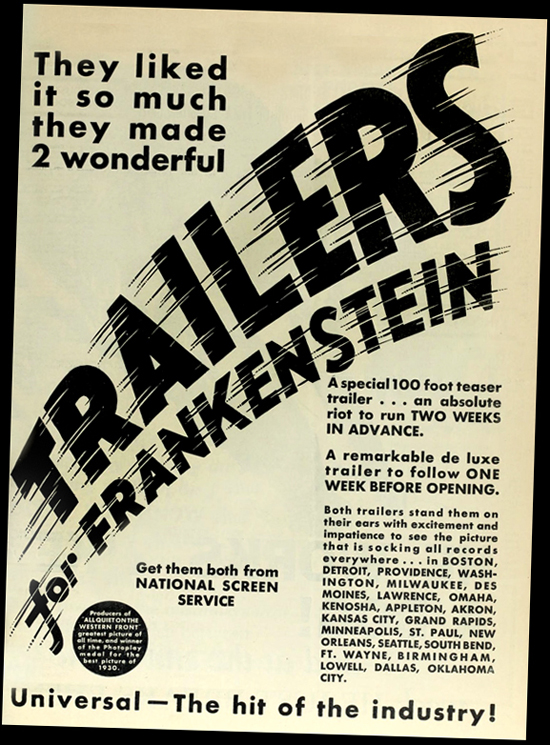
The title rockets across the page on speed lines: They liked it so much, they made 2 wonderful Trailers for Frankenstein! This is another trade ad aimed at exhibitors, from the December 2, 1931 issue of the industry newspaper Film Daily.


Back in ’31, movie trailers were made available to exhibitors through a single company, National Screen Service. It was a much more practical arrangement than having individual theater owners deal with any number of sources in an era when countless Hollywood studios vied for screen space. Within the decade, NSS would begin producing and distributing posters and other print materials, eventually becoming the exclusive purveyor for all movie advertising in North America. Studios turned their advertising campaign over to NSS, and exhibitors could order from, or walk into a local NSS “exchange” office to buy or rent whatever posters, stand-ups or lobby card sets they needed for their front of house displays.

NSS went out of business in the 80s with the rise of the multiplex, after on-the-spot theater ballyhoo had gone out of fashion and films were now promoted with a single, standard-size poster.

Coming Up: Carl Laemmle has a talk with exhibitors.


April 29, 2012

Everybody Shivered and All Had a Good Time

James Whale’s Frankenstein, opening in selected cities on November 20, 1931, was an instant hit. Pre-release ballyhoo had promised it would “out-Dracula Dracula”, and first day newspaper ads featuring its baleful Monster brought out the crowds. Within a week, Universal was already touting its box-office, Standing Room Only business as the season’s sensation.

Quoting Detroit papers and boasting record-breaking showings in Washington, Providence and Milwaukee, this ad, the first of three published in quick succession and aimed squarely at exhibitors, appeared in the New York-based Film Daily on Wednesday, November 25.

Check back here this week, I’ll be posting two more Universal trade ads.

April 26, 2012

In For a Shock

“Tells the great story as Mary Shelley wrote it…” Well, not quite. In fact, Frankenstein: The True Story (1973), as written by Don Bachardy and Christopher Isherwood, was one of the most innovative and over-the-top re-imagining of the story ever filmed, owing more to Hammer Films’ Frankenstein series — including the services of makeup man Roy Ashton and the stages of Pinewood Studios — than anything Mary ever wrote.

The ad copy may be all wrong, but the beautiful stippled artwork, artist unknown, is perfect. Michael Sarrazin played the decaying monster in this TV movie, but the unraveling bandages in the illustration show eyes and a nose that obviously belong to Boris Karloff.


Related:

April 23, 2012

The Posters of Frankenstein :
Belgian Frankenstein Meets the Wolf Man


A seminal film, Frankenstein Meets the Wolf Man (1943) brought together horror stars Lon Chaney, Jr., and Bela Lugosi as Universal’s fiercest monsters, paving the way for portmanteau Monster Rallies, eventually throwing Dracula, mad scientists and hunchbacked assistants, and even an Invisible Man cameo into the mix, culminating with Abbott and Costello Meet Frankenstein (1948) and leading to countless multiple monster films still essayed to this day, notably in the 2004 bastardization, Van Helsing.

Universal’s ad campaign for Frankenstein Meets the Wolf Man was singularly dramatic, its posters dominated by a rip-roaring pulp-style painting of the two horrors having at it. Here, a beautifully done Belgian version in French and Flemish reprises the monsters battling over a spilled blonde, with a tacked-on glamour clinch portrait of non-monstrous leads Ilona Massey and Patrick Knowles.

The artist, unfortunately, is unidentified. The printer, L. F. De Vos & Cie of Antwerp, was a major publisher of books, and travel and film posters. Perhaps the company’s most famous contributor was René Magritte who designed a couple of straight, workmanlike movie posters during a make-ends-meet fling with commercial art in the mid-Thirties. 

April 17, 2012

Frankenstein en français


Playwright Nick Dear’s adaptation of Frankenstein, made into the hit play of 2011 by director Danny Boyle for Britain’s National Theater, is being adapted to French for the Québécois theater.

Translated by Maryse Warda, Frankenstein is to be mounted for the 2013 season in two of Québec’s most prestigious theatres. It will premiere at Québec City’s Théâtre du Trident on January 15, 2013, and later move to Montréal’s Théâtre Denise-Pelletier. As with the original British version, it is planned for the two lead actors to play both parts, appearing as Victor Frankenstein or The Creature on alternate evenings.

Bringing Dear’s Frankenstein to the French stage is a project nurtured by director Jean Leclerc. As an actor, Leclerc enjoyed an international career, with several American television credits. One of his most prominent roles stateside came in 1978 following Frank Langella and Raul Julia as Broadway’s Dracula, in a famous production designed by Edward Gorey.

The pre-production poster seen here was photographed by Hélène Bouffard and Stéphane Bourgeois for Dièse Design. 

April 12, 2012

The Art of Frankenstein : Fred Kulz


An in-house artist for Universal in the Thirties, Fred Kulz painted the first Frankenstein poster in early 1931, back when Bela Lugosi was still attached and well before its Monster was designed. Kulz improvised a wild-eyed giant striding across a modern metropolis. The process repeated in June 1934 when Kulz created the first color art for the upcoming Bride of Frankenstein, basically with nothing to go on, save a title.


Published in the June 2-June 9, 1934, double issue of the Universal Weekly trade magazine, the two-page spread shows The Monster, framed in smoke, throwing a massive protective arm over The Bride, here depicted as a waif-like, kohl-eyed goth girl in a delicate wedding dress. The background shows a blasted landscape and, in the distance, the iconic burning windmill.

Information about Fred Kulz is slowly coming to light. Kulz, we learn, was active in the early 1890s and prolific into the Twenties as a designer and artist, equally at ease with photo paste-ups or elegant pen and ink drawings, for sheet music covers. He produced a number of color covers for magazine and newspaper supplements, many of them for Boston-based papers, in a very elegant and highly detailed Art Nouveau style. By the late Twenties, as a movie poster artist, he had switched to a robust, pulp magazine style packed with action, often painted in bold colors.

The Bride pre-production art has James Whale firmly in charge but no actors are named, not even Karloff. Elsa Lanchester would be cast much later. The ad copy is meant to pump up exhibitors: “Can you imagine the advertising you can do on this one?”


Fred Kulz would produce more art for Bride of Frankenstein, this time with Elsa in ghostly profile, in March of 1935.


Images from the collection of Rick Payne.